
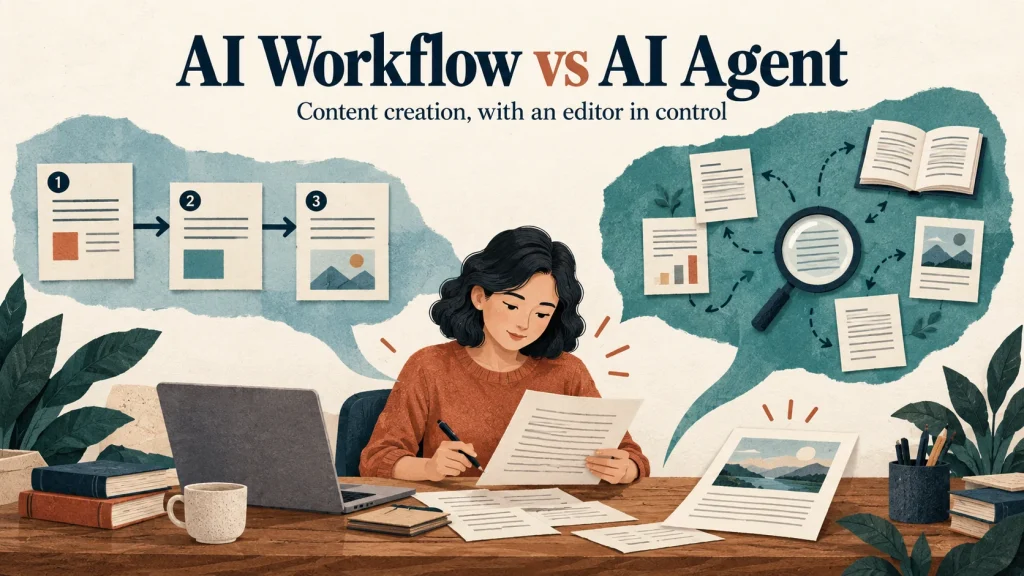
There is a need for you to complete a blog post by Friday. The assignment brief is already approved but there is an issue with the age of a particular statistic, discrepancy among top ranking articles and the fact that the document still needs to be proofread before being posted on WordPress. The AI workflow vs AI agent comes into play in deciding whether the software follows your production process or decides what to analyze next.
Quick answer: Use an AI workflow when you can define the stages and handoffs in advance: brief, outline, draft, review, and publishing approval. Use an AI agent for a bounded, open-ended task, such as investigating conflicting sources and recommending a better angle. A person should decide what the article claims, verify its evidence, and approve publication. The two approaches can work together.
Start With the Article You Actually Need to Publish
AI Workflow vs AI Agent: Start With a Clear Brief
Imagine a small business is preparing a post about reducing late-delivery complaints. Its writer has an approved brief, a customer-service policy, and a deadline. The article needs practical advice, current supporting information, and a link to a relevant page on the business’s site.
Some parts are easy to map. The brief must be checked before drafting; the draft needs an editor; the editor must approve it before it is scheduled. Other parts are less certain. If two sources describe different causes of delivery delays, someone has to find out whether they measured the same thing. If the research does not answer what customers actually ask, the angle may need to change.
That split—known production stages versus uncertain investigation—is more useful than asking which technology sounds more advanced.
When Is an AI Workflow Enough for Content Creation?
AI Workflow vs AI Agent: Map the Repeatable Stages
An AI workflow for content creation follows a path the team defines. It might look like this:
Approved brief → outline draft → editor checks angle → article draft → source and link check → final approval → schedule.
The stages can include AI. One step may propose an outline from the brief; another may suggest a meta description or identify missing subheadings. But the team defines when each step runs and what happens if the output fails review. A draft with unsupported claims goes back to the writer instead of advancing to publication.
This is useful when your team produces similar types of content each week. A product update, for instance, might always need the same specifications, legal review, image check, and sign-off. An editorial workflow makes those handoffs visible, even if the words in each post differ.
There is an important limit: fixed steps do not produce identical writing. If a generative model drafts the introduction twice, its wording may change. A workflow gives you a predictable process, not a guarantee of accurate, original, or consistent prose. The editor still has to read what it produced.
A solo writer can use the same principle without buying complex software. A repeatable brief template, a checklist, and a manual review point are already a useful content process. Add automation when repeated handoffs or copying between tools are consuming time.
When Does an AI Agent Earn Its Place?
AI Workflow vs AI Agent: Investigate Uncertain Research
Suppose the delivery article’s research hits a problem. One source discusses courier delays, another covers incomplete addresses, and the shop’s own support tickets suggest customers are most frustrated by unclear tracking updates. A fixed instruction to “summarize these three sources” might miss the real question.
A limited AI agent for content creation could be asked to investigate: Which customer problem is best supported by our approved sources and anonymized support notes? Identify gaps, show the evidence for each possible angle, and recommend one direction. It may decide to compare definitions, look for a missing source, or ask for clarification when the evidence is too thin.
The agent chooses its next step within the tools and access it has been given. It does not need permission to publish, edit live pages, or present an unverified claim as fact. Its useful output is a reviewable research note: the proposed angle, source links, conflicting findings, and unanswered questions. The editor makes the call.
That is agentic AI in a practical sense: adaptable task execution within boundaries. It does not mean the system is a better writer, permanently learns from every assignment, or should run the whole content department. If the topic is straightforward and the brief is complete, an agent may add cost and checking without improving the post.
An Illustrative Brief: One Article, Two Ways to Handle It
AI Workflow vs AI Agent: Compare One Content Brief
A small shop’s content manager prepares this brief:
Working title: Why Does My Order Have Two Tracking Numbers?
Reader question: Does a second tracking number mean my order is lost?
Approved information: Orders sometimes ship in separate parcels. Tracking updates can appear at different times.
Do not claim: That either parcel will arrive on a specific date without checking its current status.
Final approver: Content manager.
In a workflow, the brief moves through fixed steps: create an outline, draft an explanation, check every delivery claim against the approved information, then send the draft to the editor. If the draft promises that both parcels will arrive tomorrow, the editor removes the promise before publication.
An agent receives a narrower question: “What important customer question does this brief fail to answer?” It reviews the approved information and might flag a gap: the brief explains why there are two numbers but does not tell the reader what to do when one number has no update. The editor decides whether the shop’s actual policy supports adding that advice.
The workflow keeps production moving. The agent helps investigate a gap. Neither can invent the shop’s policy or approve the final article.
AI Workflow vs AI Agent: Divide the Editorial Work
| Content task | Better starting point | What a person checks |
|---|---|---|
| Move an approved brief through drafting, editing, and approval | Workflow | Each handoff happened; rejected work returned to the right person |
| Turn a complete brief into an outline or first draft | AI step within a workflow, or a writing tool | Search intent, factual claims, usefulness, and voice |
| Investigate conflicting sources or an unclear angle | Agent with limited research access | Whether its evidence supports the recommendation |
| Suggest internal links and image descriptions | Workflow or bounded agent, depending on the task | Links are relevant and image text is accurate |
| Approve claims, byline, and final publication | Human editor | The finished page is accurate and ready for readers |
For AI workflow vs AI agent, the dividing line is who chooses the next meaningful step. In a workflow, the path is designed before the work begins, even if a branch routes a failed draft back for revision. In an agent task, the system may choose its next source or action after seeing what the earlier step revealed.
The labels can overlap. An agent can sit inside a workflow for one research stage. An AI content workflow can include several AI calls without becoming an agent. A product marketed as an “AI content generator” may simply produce a draft from a prompt; that alone does not show that it can investigate, use tools, or manage editorial decisions.
Anthropic’s guide to building effective agents distinguishes predefined workflows from agents that choose their processes and tools as they work.
Avoid the Mistakes That Slip Into Published Content
AI Workflow vs AI Agent: Check Sources and Claims
A content process can look efficient while quietly moving errors downstream. These are the failures to plan for:
- Invented citations: A draft names a report that does not exist, or cites a real report for a claim it never made. Ask for the underlying source and check the passage yourself.
- Outdated facts: A source may have been accurate when published but no longer answers a current question. Record the publication date and verify time-sensitive claims before using them.
- Missed search intent: A post titled as a practical guide spends half its length defining basic terms. Compare the draft with the reader’s actual question, not just its keyword list.
- Repetitive language: Several posts generated from one template may repeat the same opening, examples, and advice. Add information drawn from your audience, product, or editorial experience.
- Irrelevant internal links: An automated suggestion can match a word without helping the reader. Open the destination and check whether it genuinely continues the topic.
- Unapproved publishing: A capable agent with CMS write access may change a live page before someone checks the facts or formatting. Start with research and draft permissions; make publishing a separate approved action.
None of these problems disappears because the system calls itself an agent. Some are easier to trace in a workflow because the team can see which stage passed the bad output along. An agent needs a record of its sources and actions so an editor can review the path it took.
Practical rule: If a mistake would affect a customer, a legal claim, a price, or your site’s credibility, put an explicit person at that approval point. Human-in-the-loop approval should be an actual pause in the process, with someone responsible for checking and accepting the work—not a label on a dashboard.
Build a Hybrid Process Without Losing Editorial Control
AI Workflow vs AI Agent: Combine Research With Approval
The delivery article offers a sensible way to combine both approaches:
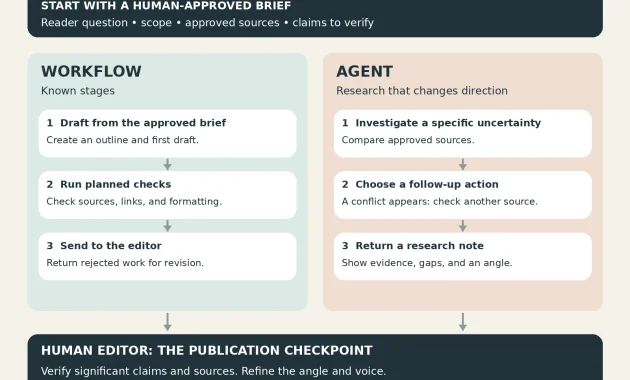
- The editor approves the brief. It states the audience, reader question, scope, claims to verify, and sources the team may use.
- The workflow creates the production tasks. It assigns the outline, draft, source check, and review in a known order.
- A limited agent investigates one uncertainty. It compares the conflicting delivery information and returns a sourced recommendation. It cannot publish or alter the approved brief on its own.
- The writer uses that finding. They decide which advice belongs in the article and add an example that explains it plainly.
- The editor checks the finished page. They verify claims, links, byline, image rights, and whether the article answers its promised question before scheduling it.
This approach gives content operations a dependable structure while allowing flexible research where it has a purpose. You can also keep the agent out of the process entirely until a recurring research problem justifies it.
If you’re evaluating platforms for the structured parts, our AI automation tools guide explains limits such as workflow runs, pricing, and data access. Choose the tool after you can describe the job and its approval points. Explore our AI automation tools guide before choosing a platform for your content workflow.
Give the Workflow Material Worth Writing About
It can produce varied wording, but variation is not the same as original reporting or useful insight. A model might rewrite a familiar list of tips in five different styles while saying nothing a reader could not find elsewhere.
Give the process something specific to work with: a real customer question, a product limitation, an editor’s observation, or a clearly documented comparison. In our example, anonymized support tickets might show that customers ask why two tracking numbers disagree, rather than simply where is my order? That observation could change the article’s structure. Do not claim such an insight came from customer data unless you actually reviewed it.
Similarly, plagiarism and AI-detection checks are separate from editorial quality. A low similarity score does not establish that a claim is correct; an AI-detection result cannot prove who wrote the article. The final copy needs a source check, a careful edit, and a clear answer to the reader’s problem.
Measure the Work After the First Draft
AI Workflow vs AI Agent: Measure Editing Time and Errors
Compare completed articles, not first drafts. For two or three representative posts, note how long the team spends on the brief, research, drafting, fact-checking, revisions, and upload. Count factual corrections, unsupported claims, broken links, and missed deadlines. Include the time spent supervising the system and the cost of its runs.
For a routine product update, a workflow may remove repetitive handoffs and finish with fewer corrections. For an unfamiliar, contested topic, a research agent might help uncover a useful angle—but only if the editor can inspect its sources without spending more time untangling them than they saved.
Ask three questions before expanding the system: Did the article answer a real reader question? Could an editor verify every significant claim? Was the total work lower after review? Traffic and engagement can help later, but they are affected by many factors beyond the workflow. Do not credit an agent with rankings merely because it helped produce a page.
A Simple Decision Checklist for Your Next Post
AI Workflow vs AI Agent: Choose for Your Next Article
Choose a workflow when the brief is settled, the stages recur, the inputs are dependable, and the team needs clear handoffs. Choose a bounded agent task when the research direction depends on findings you cannot predict ahead of time. Use both when a structured publishing process contains one genuinely open-ended investigation.
Keep the editor responsible for the angle, facts, voice, and final approval in every case. That is the most practical answer to AI workflow vs AI agent for a writer, solo publisher, or marketing team: give software the repeatable work and the limited investigation it can perform well, then judge the finished article as a reader would.
Is an AI content workflow the same as an AI agent?
No. A workflow follows defined stages; an agent can select its next steps within its tools and permissions.
Can an AI workflow research and write a blog?
Yes, it can include research and drafting steps, but a person must verify sources and edit the final claims.
Should an AI agent publish blog posts automatically?
For a new setup, keep publishing behind editorial approval until you have tested its work and permissions.
Which is better for a solo content writer?
Start with a repeatable workflow; add an agent only when open-ended research regularly takes substantial time.
Can an AI agent work inside an editorial workflow?
Yes. Give it a specific research task, then return its findings to the writer or editor for review.
