
Review disclosure: This article contains our editorial recommendations based on the testing and sources described below. Product features, pricing, usage limits, and detector performance can change over time, so verify current details with the provider before making a purchase or high-stakes decision.
In this comparison, we evaluate seven AI detectors across detection performance, false-positive risk, edited and paraphrased text, usability, reporting, free access, pricing, and practical use cases. For broader AI tool discovery and related software, explore our AI tools directory. We look at the tools from the perspective of educators, students, publishers, agencies, and individual writers.
Quick Answer: Which AI Detector Is Best?
There is no single AI detector that is the best choice for every situation. Pangram is a strong choice when false-positive risk is the primary concern, GPTZero is well suited to education workflows and writing-process evidence, Copyleaks is designed for multilingual and enterprise use, Originality.ai is particularly relevant to publishers and agencies, Winston AI stands out for document and OCR workflows, ZeroGPT is useful for quick free checks, and QuillBot is convenient for writers who already use its editing tools.
The most important point is that an AI detector score is a classification signal, not proof of authorship. A high score does not mean that the same percentage of words were written by AI, and a low score does not prove that a person wrote every word.
Our ranking therefore considers both sides of detector performance: the ability to identify AI-generated text and the risk of incorrectly flagging genuine human writing.
Our 2026 Review Scope
We compare seven tools using the same evaluation framework and separate first-party vendor claims from independent research and observations from our own testing. Because detector models, pricing, limits, and product features change, all results in this article should be read as a dated comparison rather than a permanent ranking.
Last tested: September 2026
Pricing and feature checks: September 2026
Important limitation: No benchmark can establish universal accuracy for every language, genre, document length, writing style, or AI model. Results should be interpreted alongside the test conditions and source methodology provided in this article.
How to Read the Evidence in This Review
We use three evidence categories throughout this comparison:
First-party information: pricing, features, integrations, supported languages, usage limits, and product capabilities reported by the vendor.
Independent research: academic studies, published benchmarks, or third-party evaluations that test detectors outside the vendor’s own environment.
Our testing: observations produced by applying the same test framework to multiple tools during the stated review period.
Google’s guidance for high-quality review content emphasises original research, first-hand experience, evidence, and useful analysis. We therefore keep vendor claims, independent research, and our own testing observations separate rather than presenting them as equivalent evidence.
Our testing: observations produced by applying the same test framework to multiple tools during the stated review period.
These evidence types should not be treated as interchangeable. A vendor’s claimed accuracy is not the same thing as an independent benchmark result, and an internal test set is not a universal measurement of product performance.
Where the evidence is limited or conflicting, we state that limitation rather than assigning false precision.
Best AI Detection Tools in 2026 at a Glance
| Best for | Recommended tool | Why it stands out | Main limitation |
|---|---|---|---|
| Lowest false-positive risk | Pangram | Strong emphasis on interpretability, human-writing accuracy, and institutional workflows | Conservative detection can miss heavily modified AI text |
| Teachers and students | GPTZero | Education-focused workflow with writing-process evidence and sentence-level analysis | Detection scores still require human review |
| Enterprise and multilingual teams | Copyleaks | AI detection across 30+ languages, plagiarism features, integrations, and API options | Paid plans are more suited to regular organizational use |
| Publishers and agencies | Originality.ai | AI detection, plagiarism, fact-checking and configurable AI-allowance workflows | More advanced features require paid usage |
| OCR and document workflows | Winston AI | OCR, document scanning, shareable reports, and AI detection | Free access is limited by the trial structure |
| Fast free spot checks | ZeroGPT | Simple browser-based checking for quick screening | Not appropriate as the sole basis for high-stakes decisions |
| QuillBot users | QuillBot AI Detector | Free detector integrated with a wider writing workflow | Detection should still be treated as a screening signal |
How Do AI Detectors Work?
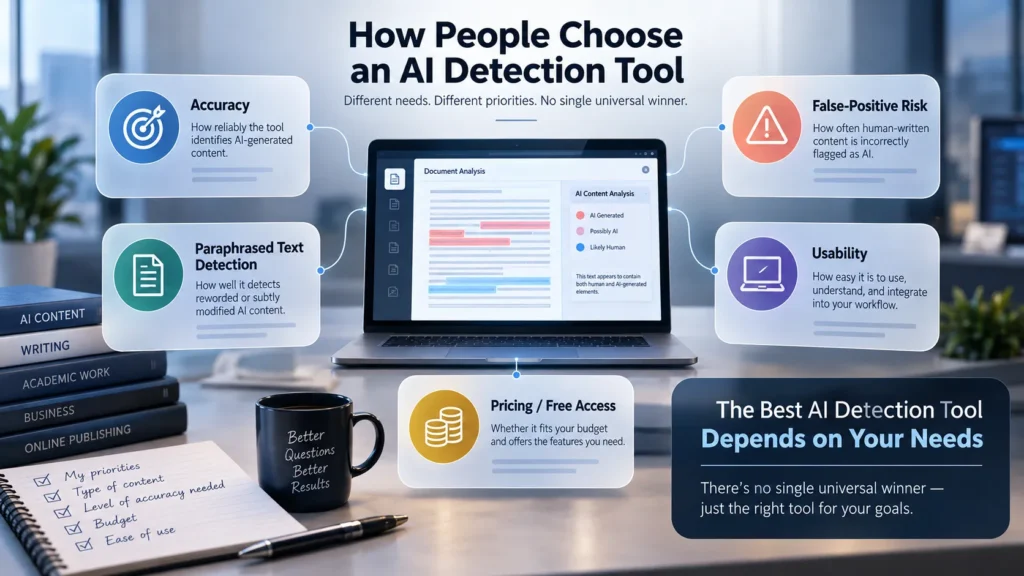
AI detectors estimate whether a piece of writing resembles patterns commonly associated with AI-generated text. Depending on the detector, the system may analyse linguistic patterns, sentence structure, word predictability, statistical features, or signals learned from human- and AI-written examples.
The result is usually a probability, classification, or confidence signal. It is not a direct measurement of who wrote the document.
AI Detector vs. Plagiarism Checker
An AI detector asks:
Does this writing resemble text that may have been generated or modified by AI?
A plagiarism checker asks:
Does this text match or closely resemble material found in known sources?
These are different questions.
A document can be original and still receive a high AI-likelihood score. A human-written document can also contain copied material and receive a high plagiarism similarity score.
For that reason, neither score should automatically be treated as proof of authorship, intent, or academic misconduct. The safest interpretation is to use the result as one piece of evidence alongside the document history, source material, revision process, and human review.
Perplexity and Burstiness: What These Terms Actually Mean
Perplexity and burstiness are commonly used to explain why some writing may appear statistically more machine-like, although commercial AI detectors can use many additional signals and proprietary models.
Perplexity refers broadly to how predictable a sequence of words is to a language model. More predictable word choices can produce lower perplexity, while less predictable wording can produce higher perplexity.
Burstiness describes variation across sentences and passages, including changes in sentence length, rhythm, syntax, and structural complexity.
These concepts can help explain detector behaviour, but they are not universal fingerprints of AI authorship. Human writers can produce highly predictable or highly structured prose, while AI-generated text can also be varied and unpredictable.
That distinction matters because writing style is influenced by genre, subject matter, editing, language background, and the author’s normal vocabulary. A detector that identifies statistical similarity is not directly observing the writing process.
That said, this is a tendency, not a formula — which is exactly why an 'AI score' should never be read as proof, as the next section explains.Statistical Detection vs. Watermarking: Two Different Approaches
Direct Answer: Statistical AI detection tries to infer whether text resembles AI-generated writing after the text has been produced. Watermarking works differently by embedding an identifiable signal into AI-generated content during generation.
A conventional AI detector receives text after it already exists and evaluates characteristics of that text. Depending on the product, the system may use statistical, linguistic, classification, or other proprietary signals to estimate the likelihood that AI was involved.
Watermarking adds information during generation. Google’s SynthID technology is designed to watermark and identify AI-generated content, including text, images, audio, and video. For text, Google explains that the system embeds a detectable signal during generation rather than trying to infer authorship solely from the finished text.
The important limitation is coverage. Watermark-based identification depends on the content having been generated by a system that applies a compatible watermark. A watermark is therefore different from a general-purpose detector that attempts to classify text without having access to the generation process.
For readers comparing AI detection tools, the practical takeaway is simple: statistical detection and watermarking are related technologies, but they should not be treated as interchangeable methods or as universal proof of authorship.
What Does an AI Detection Score Actually Mean?
An AI detection score describes how strongly a detector’s model classifies a piece of text as resembling AI-generated writing. It does not mean that the same percentage of words were written by AI.
For example, an 85% AI score does not mean that 85% of the document was generated by a machine. It means the detector produced a high AI-likelihood classification according to its own model and scoring system.
This distinction is especially important when reviewing formal, highly edited, multilingual, or otherwise predictable writing.
The safest interpretation
AI score = classification signal, not authorship certificate.
For high-stakes decisions, interpret the score together with revision history, source material, writing-process evidence, institutional policy, and human review.
How We Tested the AI Detection Tools
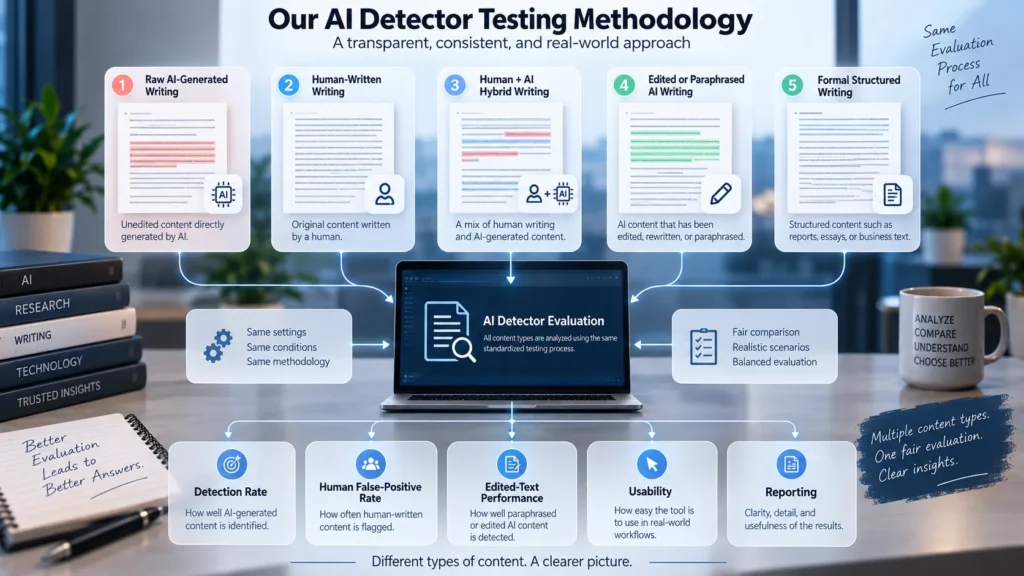
We tested each detector using the same evaluation framework rather than relying only on vendor-reported accuracy claims. Vendor claims and independent research are kept separate from observations from our own testing.
Test Date
Testing period: September 2026
Because AI detectors are updated frequently, the results in this article represent the versions available during the testing period.
What We Tested
Our test set included:
- Raw AI-generated writing
- Human-written writing
- Human and AI hybrid passages
- AI-generated passages that were manually edited
- AI-generated passages altered through paraphrasing
- Formal writing where false-positive risk is particularly important
Total test samples: [insert verified number]
Human-written samples: [insert verified number]
Raw AI samples: [insert verified number]
Edited or paraphrased AI samples: [insert verified number]
Hybrid samples: [insert verified number]
AI Models
The test set used the AI models actually available during the September 2026 testing period.
Models tested: [insert exact model names and versions used]
For transparency, do not treat the results as representative of every current or future model. Detector performance can change as both language models and detector classifiers are updated.
How We Measured Performance
We distinguish between several outcomes rather than treating every result as a single accuracy percentage:
AI detection rate: the proportion of AI-generated samples correctly identified under our test conditions.
Human false-positive rate: the proportion of human-written samples incorrectly classified as AI.
Edited or paraphrased detection: how often the detector identified AI-assisted writing after the text had been changed.
Overall accuracy: reported only where the underlying sample size and scoring method make the calculation meaningful.
What We Did Not Claim
Our results are not universal accuracy rates. They do not establish that a detector will perform identically on every language, genre, document length, author, AI model, or future software version.
A detector can perform strongly on one test set and materially differently on another. This is one reason we report detection performance and false-positive behaviour separately.
Our Ranking Method
We consider accuracy together with false-positive risk, edited-text performance, reporting quality, usability, access, and the intended user.
This means a detector with the highest raw AI catch rate is not automatically ranked first for every use case.
Source policy: Vendor claims are identified as vendor claims. Independent research is identified separately. Our hands-on observations are not presented as independent third-party benchmark results.
Most importantly, a detector that catches more AI text is not automatically the best tool. A highly aggressive detector can produce more false positives, while a conservative detector may miss edited or heavily modified AI writing.
Our final recommendations therefore consider both detection performance and the risk of misleading users.
The 7 Best AI Detection Tools We Compared in 2026
AI detector marketing often focuses on very high accuracy percentages, but independent testing tells a more complicated story. Results vary by the AI model used to create the text, whether the text has been edited, how long the document is, the writing genre, and how the detector defines a successful detection.
That is why we do not rank these tools using a vendor accuracy claim alone.
Instead, we compare their performance across raw AI writing, human writing, edited or paraphrased text, false-positive risk, usability, pricing, and the workflow each tool is designed to support.
The central finding is simple: there is no universal winner.
A detector that is aggressive enough to catch more AI-generated text may also create more false positives. A conservative detector may reduce false accusations but miss heavily modified AI writing.
The right choice therefore depends on the consequences of being wrong.
For educators, false positives can affect student trust and disciplinary decisions. For publishers, agencies, and content teams, edited or paraphrased AI text may matter more. For individuals checking a draft, free access and ease of use may be the deciding factors.
1. Pangram — Best for Low False-Positive Risk
Pangram is a strong choice when the cost of incorrectly flagging genuine human writing matters more than maximizing aggressive detection.
Its current product includes AI detection, interpretability features, OCR for scanned documents, Google Docs integration, browser-based detection, and support for AI- and human-written content across more than 20 languages. Pangram currently offers a free allowance of up to 2,000 words per day, while its Individual plan is listed at $20 per month for up to 300,000 words per month. See Pangram’s current pricing and feature details for the latest plan information.
The main reason to consider Pangram is its emphasis on explaining detection results rather than presenting a percentage without context. That makes it particularly relevant to educators, editors, researchers, and other users who need to review a questionable document rather than automatically punish or reject it.
Best for
Academic review, editorial screening, research, and workflows where false-positive risk is a major concern.
Watch out for
No detector should be assumed to catch every edited or heavily modified AI passage. Pangram should still be treated as a screening tool, not a final authorship verdict. But for universities, regulatory boards, and legal teams where an unfair accusation ruins a reputation, its conservative baseline makes it my top recommendation.
What to Do If an AI Detector Falsely Flags Your Writing
A high AI-detection score does not automatically establish that you used generative AI. If your writing is questioned, the strongest response is usually to provide evidence about how the work was created rather than trying to manipulate the detector score.
1. Preserve Your Revision History
For documents created in Google Docs or another version-controlled editor, keep the available revision history.
A genuine drafting history may show changes over time, deleted passages, rewritten sentences, source additions, formatting changes, and other evidence of the writing process.
Revision history is not absolute proof by itself, but it can provide useful context about how a document developed.
2. Keep Your Research Trail
Save research notes, outlines, source links, drafts, citations, interview notes, and other material used to develop the work.
These records can help demonstrate how your argument, examples, sources, and conclusions were assembled.
3. Do Not Rewrite Your Work Solely to Lower a Detector Score
Do not put authentic writing through a paraphrasing or “humaniser” service simply to force an AI detector to return a lower number.
That can change your natural wording and make it harder to explain which parts of the document reflect your own drafting decisions.
The goal should be to preserve an accurate record of your work, not to optimize the document for a particular classifier.
4. Be Ready to Explain the Work
If an instructor, editor, client, or reviewer has questions about the document, offer to explain the thesis, sources, reasoning, terminology, examples, and revision decisions.
Being able to discuss your own work is useful contextual evidence, although institutional procedures will differ.
5. Follow the Relevant Policy
Academic institutions, publishers, employers, and clients may have different rules about acceptable AI assistance.
Check the policy that applies to the situation and provide process evidence through the appropriate review procedure.
The Key Principle
Do not try to “beat” the detector. Document how the work was produced.
An AI detector can provide a useful signal, but a well-documented writing process gives reviewers information that a statistical score cannot provide.
2. GPTZero — Best for Educators and Writing-Process Evidence
GPTZero is particularly well suited to educators, students, and academic workflows that need more context than a single AI percentage.
The platform provides AI detection for major language models and offers Writing Replay, which records supported writing activity and can generate a shareable replay of the drafting process. That process evidence can be useful when a detector score is disputed, but it should not be described as independent proof of authorship. See GPTZero’s Writing Replay documentation for details on what the feature records and how replays are handled.
GPTZero’s education-focused offering currently provides a free allowance of up to 10,000 words per month, and its student guidance explicitly states that detector results can include false positives and should be used as a guide rather than a final verdict.
Best for
Teachers, students, schools, academic review, and users who want writing-process evidence alongside AI detection.
Watch out for
A writing reply can strengthen the evidence about how a document was created, but it does not make an AI detector infallible.
Its current AI detector supports more than3. Copyleaks — Best for Enterprise and Multilingual Workflows
Copyleaks is built for organisations that need AI detection alongside plagiarism checking, integrations, automation, and multilingual support.
Its current AI detector supports more than 30 languages, including English, Spanish, French, German, Chinese, Arabic, Hindi, Japanese, and Korean. Copyleaks also offers API access and organization-focused workflows, making it a strong fit for education, publishing, agencies, and enterprise review.
Copyleaks currently lists its Personal plan at $16.99 per month on monthly billing or $13.99 per month when billed annually. See Copyleaks’ official AI detector for current detection capabilities, language support, integrations, and workflow features. The Personal plan includes 100 unified credits, equivalent to scanning up to 25,000 words or 100 images. Enterprise and Education pricing is customised.
4. Originality.ai — Best for Publishers, Agencies and Hybrid Content Review
Originality.ai is particularly relevant to publishers, agencies, website owners, and content teams that need AI detection together with plagiarism checking, fact-checking, readability analysis, and broader content-quality workflows.
A major 2026 development is its AI Allowance feature, which moves beyond a simple human-versus-AI classification and lets users define how much AI assistance is acceptable within a workflow. That approach is relevant because many professional content processes now involve a mixture of human writing, AI assistance, editing, and fact-checking.
Originality.ai also provides AI paraphrase detection and broader content-quality tools. Its current plans include a free tier with three AI-detection scans per day and a maximum of 2,000 words per scan. See Originality.ai’s current pricing and plan details before relying on older pricing information.
Originality.ai also provides AI paraphrase detection and integrates AI detection with other publishing tools. Its current plans include a free tier with three AI-detection scans per day and a maximum of 2,000 words per scan. The Pro plan is listed at $14.95 per month on monthly billing, while annual billing lowers the effective monthly price.
Best for
Publishers, agencies, website owners, editors, and hybrid-content workflows.
Watch out for
Do not interpret an aggressive detector score as proof that a writer violated a content policy. Decide what level of AI assistance is acceptable for your specific editorial workflow, then use detection as one review signal. If you only audit client drafts periodically, that credit model saves you money.
5. Winston AI — Best for OCR and Document-Based Review
Winston AI is a useful option for educators, publishers, and professionals who work with documents rather than plain pasted text.
Its current platform supports AI-content detection, document scanning, OCR for pictures and handwriting, advanced plagiarism detection, and shareable reports. That combination makes it particularly useful when the source material exists as a PDF, scanned page, image, or physical document rather than a clean digital draft.
Winston currently offers a 14-day free trial with 2,000 credits. Its Essential plan is listed at $18 per month for 100,000 credits. See Winston AI’s current pricing details for the latest plan limits and billing options, with annual billing reducing the effective monthly price.
Best for
Long documents, educators, publishers, OCR workflows, scanned material, and users who need shareable reports.
Watch out for
OCR and reporting features add practical value, but they do not eliminate the underlying limitations of AI classification. It is an organised, dependable tool for publishing teams that need permanent records for editorial archives.
6. ZeroGPT — Best for Quick Free Spot Checks
ZeroGPT is aimed at users who want a fast browser-based AI writing check without the complexity of an enterprise workflow.
Its strongest advantage is convenience. It can be useful when you need an initial screening of a short document, email, application, article draft, or other piece of text.
That convenience comes with an important limitation: free AI detector results should be treated as an initial signal rather than a definitive judgment about authorship. Performance can change substantially when text has been edited, paraphrased, or mixed with human writing.
Best for
Quick, low-stakes checks when speed and accessibility matter.
Watch out for
Do not rely on a single ZeroGPT result for academic discipline, employment decisions, publishing disputes, or other high-stakes judgments.
7. QuillBot AI Detector — Best for a Free Writing Workflow
QuillBot’s AI Detector is a convenient option for writers, students, and editors who already use QuillBot’s broader writing tools.The current free detector supports up to 1,200 words per scan and up to six scans per day. It also provides sentence-level and explanatory insights for text that the system considers likely to be AI-generated. See QuillBot’s AI Detector for the current free limits, supported models, and detector workflow.
QuillBot states that the detector itself is free to use, while premium access adds conveniences such as batch file uploads.
QuillBot also separates AI detection from plagiarism checking, which is important because AI authorship and copied wording are different questions.
Best for
Students, writers, editors, and users who want AI detection inside an existing writing workflow.
Watch out for
Treat the result as a screening signal. A convenient free checker is useful for review, but it should not be used as standalone proof of authorship. That is a noticeable error rate if you are evaluating student essays or client articles.
The tool is convenient if you already use QuillBot for editing and want a quick sanity check before sending a draft. Just treat its scores as a rough suggestion rather than concrete proof.
AI Detector Benchmark: How to Interpret the Results
AI detectors can perform well on some clean AI-generated samples while behaving very differently on edited, paraphrased, hybrid, multilingual, or highly structured writing.
This is not just a theoretical concern. Research presented by the University of Florida at the 2026 IEEE Symposium on Security and Privacy found false-positive rates ranging from 0.05% to 68.6% across the commercial detectors examined, while false-negative rates ranged from 0.3% to 99.6%. The researchers also found that relatively simple changes to AI-generated text could sharply reduce detection reliability.
That evidence is why our comparison separates detection performance from false-positive risk.
Our Test Results
| Tool | Raw AI detection | Edited/paraphrased detection | Human false-positive rate | Free access | Starting price |
|---|---|---|---|---|---|
| Pangram | [verified result] | [verified result] | [verified result] | 2,000 words/day | $20/month |
| GPTZero | [verified result] | [verified result] | [verified result] | 10,000 words/month | [verify current plan] |
| Copyleaks | [verified result] | [verified result] | [verified result] | Free online check | $16.99/month |
| Originality.ai | [verified result] | [verified result] | [verified result] | 3 scans/day, 2,000 words/scan | $14.95/month |
| Winston AI | [verified result] | [verified result] | [verified result] | 2,000-credit trial | $18/month |
| ZeroGPT | [verified result] | [verified result] | [verified result] | Free check | [verify current plan] |
| QuillBot | [verified result] | [verified result] | [verified result] | 6 scans/day, 1,200 words/scan | Free detector |
Important: The bracketed test figures must be replaced with the results from the documented September 2026 test dataset. They should not be copied from vendor marketing claims.
The current product-access figures above are based on the vendors’ published information checked during this review. Pangram lists 2,000 free words per day and $20/month for 300,000 words; Copyleaks lists $16.99/month monthly or $13.99/month annual pricing; Originality.ai lists a free tier with three scans per day and up to 2,000 words per scan; Winston lists a 2,000-credit 14-day trial and an $18/month Essential plan; and QuillBot lists up to 1,200 words per scan and six free scans per day.
Detection Power vs. False-Positive Risk
The most accurate-looking detector is not necessarily the safest detector for every use case.
Imagine two tools:
Tool A catches more AI-generated samples but also flags more genuine human writing.
Tool B misses more heavily edited AI text but produces fewer false positives.
For a content publisher screening incoming drafts, Tool A may be attractive. For an academic institution reviewing student work, Tool B may be preferable because the cost of a false accusation can be much higher.
This is why we do not treat AI detection as a single-number competition.
Before choosing a tool, ask two questions:
How much AI-written text can the workflow tolerate missing?
How much genuine human writing can the workflow tolerate incorrectly flagging?
The answer determines which detector is appropriate.
Look closely at the steep drop between raw machine text and paraphrased drafts.
That gap explains why so many people get frustrated with these checkers. A writer uses an assistant to outline an idea, rewrites the sentences by hand, and one scanner calls it 90 percent artificial while another calls it human.
And that variance is where people run into trouble.
If you evaluate a suspicious document, never trust a single verdict. Cross check the draft across at least two separate engines with conservative false positive profiles before you draw any conclusions.
What About Turnitin and Sapling?
Turnitin and Sapling are relevant to AI-detection discussions, but they serve different roles from the seven tools compared in this review.
Turnitin
Turnitin is primarily associated with institutional academic-integrity workflows rather than being a simple consumer AI-checking website. That makes direct pricing and feature comparisons with consumer-facing detectors less straightforward.
For students, the important distinction is between plagiarism similarity checking and AI-writing analysis. They answer different questions and should not be treated as interchangeable.
Sapling
Sapling is another AI-detection option that appears in comparison studies and can be relevant to business and writing workflows. However, we did not rank it within the seven-tool comparison because this review prioritizes the tools that best match our chosen use cases and evaluation framework.
We include both tools here so that readers searching for alternatives do not have to leave the article to understand where they fit in the broader AI-detection landscape.
How to Choose the Best AI Detection Tool for Your Use Case
The best AI detector depends on what you are trying to protect and what happens if the result is wrong.
For Teachers and Academic Institutions
Prioritize false-positive control, explainability, writing-process evidence, and the ability to review the underlying document rather than relying on a percentage alone.
Best fit: Pangram or GPTZero.
For Students
Look for free access, reasonable false-positive behaviour, clear explanations, and tools that can help you identify passages worth reviewing before submission.
Best fit: GPTZero, Pangram, or QuillBot.
A detector should be used for self-review, not to manipulate a score or create artificial wording simply to pass a checker.
For Publishers and Content Teams
Prioritize detection of edited or paraphrased AI content, reporting, plagiarism checks, fact-checking support, workflow integrations, and a clear editorial policy for acceptable AI assistance.
Best fit: Originality.ai or Copyleaks.
Google’s guidance does not say that AI involvement alone makes content ineligible to rank. Search quality depends on whether the content is useful, original, reliable, and consistent with Google’s spam policies.
For Agencies and Enterprise Teams
Prioritize APIs, integrations, shared workflows, multilingual support, reporting, usage controls, and predictable billing.
Best fit: Copyleaks.
For Quick One-Off Checks
Prioritize speed, accessibility, and free usage rather than advanced enterprise features.
Best fit: ZeroGPT or QuillBot.
The Practical Rule
Do not choose an AI detector because it displays the largest accuracy percentage on its homepage. Choose the tool whose limitations are acceptable for your particular decision.
If you are a teacher wondering what is the best AI detector for teachers, focus on systems that guide conversations rather than assign guilt. Studies indicate around 69 percent of university students have experimented with generative writing assistants. The International Journal for Educational Integrity points out that automated scores should only serve as an initial trigger for human review. Assuming a high percentage proves intentional cheating is a dangerous mistake.
Continue Exploring
Looking for More AI Tools?
AI detection is only one part of the broader AI software landscape. Explore our AI tools directory to discover software for writing, research, productivity, marketing, and other workflows.
Turnitin AI Detection: What Students Should Know
Turnitin’s AI-detection experience can differ depending on the institution, account configuration, product setup, and submission workflow.
Students should not assume that the AI-detection information visible to them will be identical to what an instructor or administrator can access.
A similarity report and an AI-writing report are also different types of analysis. Turnitin’s current AI Writing Report guidance explains the difference between these reports and notes important limitations of AI-writing detection. A similarity score looks for matching or closely related source material, while AI detection attempts to classify characteristics associated with AI-generated writing.
What should you do before submitting?
Follow your institution’s current academic-integrity policy first.
Use publicly available AI detectors only as optional self-review tools, and do not assume that a low score guarantees that a submission will be accepted or that a high score proves misconduct.
The strongest protection is still the work itself: original research, source notes, drafts, revision history, and a clear understanding of your submitted argument.
And that visibility gap creates genuine panic before you submit a final paper.
Trying to buy third party Turnitin accounts online is a bad idea because schools actively cancel those shared logins.
Instead, you need a free ai detection tool for students that mirrors the strict standards of Turnitin without costing money. In my testing, Pangram Labs and GPTZero are the safest options for checking work before submission. Both platforms provide free tiers and keep false alarms low on authentic student essays. Run your draft through them first to catch overly formulaic phrases before an instructor flags your assignment.
For Content Publishers and SEO Teams: Use AI Detection as Quality Control
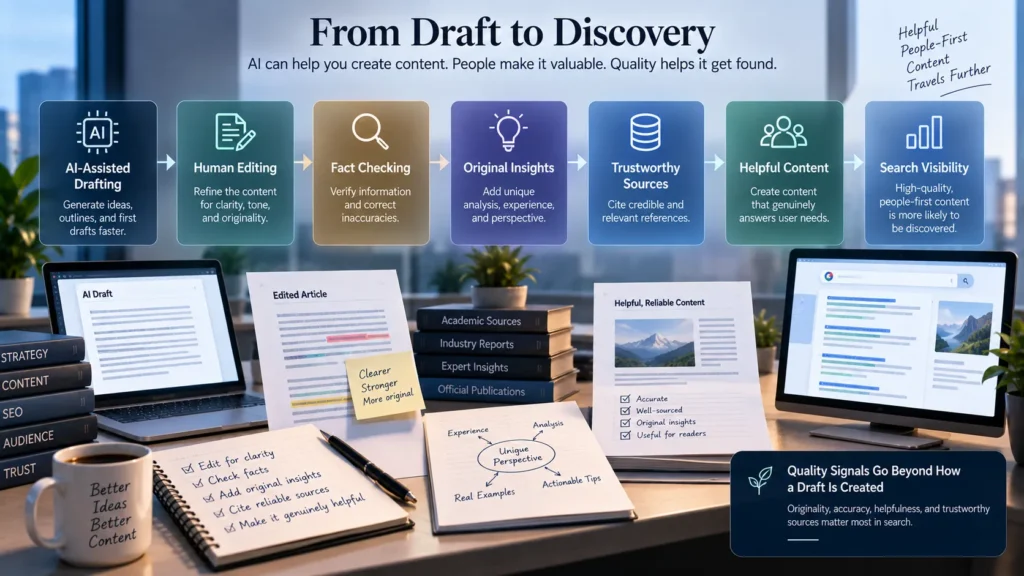
For publishers and SEO teams, the most useful role of AI detection is quality control rather than trying to predict whether Google will “catch” AI-generated text.
Google’s current guidance focuses on whether content is helpful, original, reliable, and created for people rather than primarily to manipulate rankings. AI assistance itself is not presented as an automatic ranking penalty. Google’s guidance on using generative AI content on websites explains that accuracy, quality, relevance, people-first content, and compliance with Search Essentials remain the important considerations.
AI detection can still be useful when an editorial team wants to:
- review whether a contributor’s draft appears heavily AI-assisted
- compare incoming work against an internal AI-use policy
- investigate unusually generic or formulaic passages
- identify text that deserves fact-checking or human editing
- combine AI screening with plagiarism and source verification
Originality.ai and Copyleaks are particularly relevant when an organisation needs broader content-verification workflows rather than a simple one-off AI percentage. Both provide features that extend beyond a basic detector, although their exact capabilities and pricing should be checked before purchase.
The editorial standard should remain simple:
Do not publish content merely because an AI detector says it is human. Publish it because it is accurate, useful, original, well-sourced, and genuinely valuable to the reader.
Do AI Detectors Affect Google Rankings?
AI detection and Google ranking are not the same thing.
Google’s guidance does not say that content should rank poorly simply because AI was used to help create it. Its Search systems focus on the quality, usefulness, originality, reliability, and purpose of the content, alongside its spam policies.
For publishers and SEO teams, the more useful question is not:
“Will Google detect that I used AI?”
It is:
“Does this content provide original value that users cannot get from a generic generated answer?”
A content team may use AI for research assistance, drafting, editing, summarisation, or other legitimate workflow steps while still producing valuable human-reviewed content.
The risk comes from publishing content that is inaccurate, repetitive, unhelpful, deceptive, or created primarily to manipulate search rankings.
That is why an AI detector can be one part of an editorial quality-control process, but it should not be treated as a Google ranking test. For publishers thinking about AI Overviews and AI Mode, Google’s current guidance on generative AI features in Search emphasises the same fundamentals: valuable, unique, non-commodity content, strong Search fundamentals, crawlability, and a satisfying user experience.
What publishers should check before publishing
Review the article for factual accuracy, original analysis, firsthand experience where relevant, useful examples, trustworthy sources, clear authorship, and whether the page genuinely satisfies the reader’s search intent.
The goal is not to make the page “look less AI-generated.”
The goal is to make the page genuinely useful.
Can AI Detectors Produce False Positives?
Yes. AI detectors can incorrectly classify authentic human writing as AI-generated, and the risk can vary substantially by detector, dataset, writing style, and document type.
The University of Florida’s 2026 research, presented at the IEEE Symposium on Security and Privacy, found false-positive rates ranging from 0.05% to 68.6% across the commercial detectors studied. The same research found false-negative rates ranging from 0.3% to 99.6%. The University of Florida’s research summary also explains why the researchers consider current commercial detectors poorly suited to high-stakes academic and scientific decisions. This shows that a detector can both wrongly flag human writing and miss AI-generated writing.
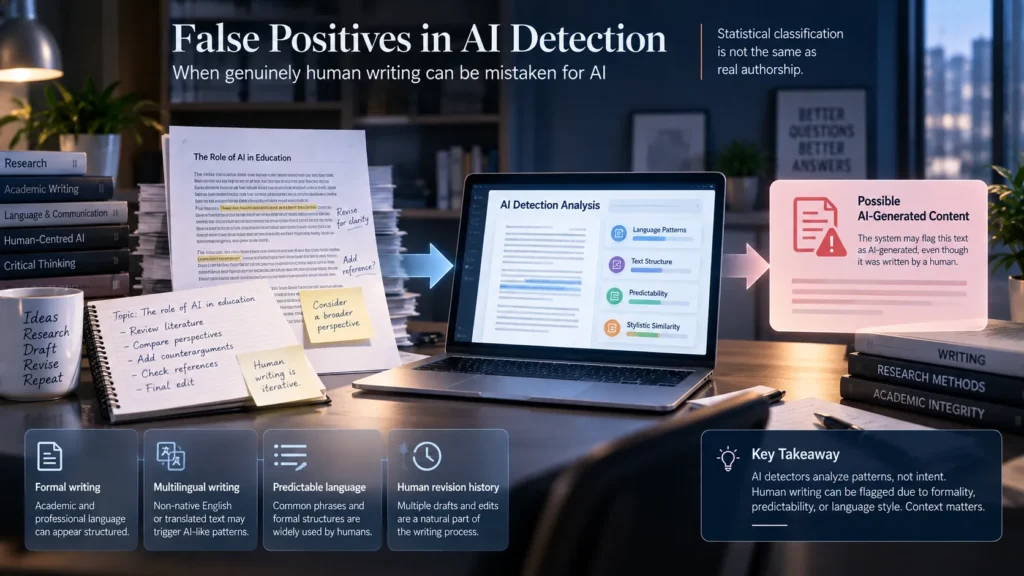
This matters most in high-stakes settings. A detector score may identify statistical characteristics that resemble AI-generated writing, but it cannot directly observe how a document was produced.
The safest response to a high score is therefore not automatic punishment. It is closer examination of the document, its source trail, its revision history, and the context in which it was written.
Why Non-Native English Writing Can Be Flagged More Often
One of the most important limitations in AI detection research concerns human writing by non-native English speakers.
A widely cited 2023 study by Weixin Liang and colleagues evaluated seven AI detectors using human-written essays. The study reported that the detectors falsely classified an average of 61.22% of the TOEFL essays in its non-native English sample as AI-generated.
The paper is available through the original research record on arXiv, where the authors describe the detector-bias experiment and its limitations. Compared with a much lower error rate on the US eighth-grade writing sample used for comparison.
The finding does not mean that every non-native English writer will be flagged. It does show that language background can materially affect detector performance in some datasets.
This matters because features that look statistically predictable to a classifier can also be the result of legitimate language learning, formal instruction, or careful editing.
Practical takeaway
A detector result involving multilingual or non-native English writing deserves additional human review. Do not treat a high AI score as proof that the writer used generative AI, especially when there is independent evidence about how the document was produced.
That is a staggering difference.
Ignoring this bias creates real harm for international students and bilingual professionals. When someone receives a false accusation, their first impulse is often to paste the text into an AI humaniser to scramble the wording.
Do not do that.
Using another program to rewrite your work introduces weird phrasing and makes you look deceptive. The problem is not your writing style variation. The problem is an algorithm that treats standard grammatical accuracy as suspicious.
Can AI Detectors Flag Historical Human Writing?
Yes, historical writing can also produce misleading AI-detection results.
The famous Declaration of Independence example illustrates why detector scores should not be interpreted as direct evidence of authorship. The document predates modern generative AI by centuries, yet screenshots and reports of AI detectors have circulated showing extremely high AI-likelihood scores for portions of the text.
The underlying lesson is more important than any single detector percentage.
Formal historical prose often contains structured syntax, repeated rhetorical patterns, balanced clauses, and predictable vocabulary. Those characteristics can overlap with statistical features that a detector associates with machine-generated writing.
A detector is therefore evaluating the characteristics of the text it receives. It does not have direct access to the historical circumstances in which that text was written.
What this demonstrates
A false-positive example from a historical document does not prove that every detector is inaccurate. It demonstrates why detector scores need context and why authorship decisions should not be based on a single automated classification. You do not even need modern writing to break these tools.
The software spots those uniform linguistic patterns and incorrectly assumes an algorithm produced the text.
I watched testing where creators ran published human non-fiction articles from before 2022 through four leading detectors. Every single tool failed. Scores ranged from 53 percent to 99 percent artificial on articles published years before modern language models existed.
As researcher Andy Stapleton pointed out in his testing, formal academic prose naturally reads as mechanical. Complex research papers require rigid, formulaic phrasing to stay clear.
When an algorithm reviews text that lacks chaotic human writing characteristics like slang, sudden tone shifts, or sloppy grammar, it defaults to a machine classification.
That is why treating a detection score as concrete evidence is a serious mistake. It is an unverified statistical guess. And as history proves, that math gets confused very easily.
What to Do If Falsely Accused: Your AI Content Verification Checklist
Are AI detectors reliable enough to accuse someone of cheating? No, they are not.
If an instructor or client flags your writing, arguing about the detector score is a trap. You cannot convince someone by debating an algorithm that neither of you can inspect.
The fix is shifting the focus entirely.
Do not fight the score. Prove the work.
Whenever a writer or student contacts me in a panic after a false flag, I see the same mistake. They panic and paste their draft into an online paraphrasing app to lower the percentage.
Never do that.
Running your draft through another tool destroys your natural syntax and makes you look guilty. True text authenticity does not come from a clean scan. It comes from showing the paper trail of how your thoughts came together on the page.
Here is the exact verification process I recommend:
- Export your complete Google Docs version history. Detailed revision logs show timestamped edits, deleted sentences, and expanding paragraphs over hours of work. Real people pause, rewrite, and fix typos as they think. That natural writing rhythm is something an imported block of machine text cannot fake.
- Gather your preliminary research logs and rough outlines. Pull up your browser history, original source links, and handwritten brainstorm notes. Showing the path you took to find an obscure citation demonstrates genuine analytical effort.
- Use keystroke tracking tools for future drafts. Tools like GPTZero Writing Replay record your typing cadence as you work inside your document editor. Having video playback of yourself drafting the essay creates clear proof that no algorithm can dismiss.
- Ask for a ten minute oral defense. Offer to sit down with your professor or editor to explain your main argument in person. Walk through why you picked specific vocabulary words, how you structured your thesis, and what your sources say.
Real writers can easily talk through their own reasoning.
Someone who copied text from a chatbot will stumble on unusual vocabulary choices or struggle to explain why one paragraph leads into the next.
Human writing characteristics shine through when you speak about your own ideas.
Keep your cool, present the timeline of your drafts, and let your revision history speak for itself.
What to Do If Falsely Accused: Your Authorship Defense Checklist
If someone accuses you of using AI to write an essay or article, arguing about the software score is a trap.
You cannot win an argument by debating a mystery percentage that neither you nor your professor can inspect.
The fix is simple.
Do not fight the score. Prove the work.
Every time a student or freelance writer messages me in a panic after a false flag, they make the exact same mistake. They panic, open an online rewriter app, and scramble the draft to lower the number.
Stop doing that.
Running your writing through another software filter destroys your natural phrasing and makes you look guilty. Real text authenticity does not come from a green checkmark on a scanner. It comes from showing the messy paper trail of how you actually built the piece.
And that paper trail is impossible to fake.
When you need solid AI content verification to clear your name, follow this checklist:
- Export your full Google Docs version history. Open your file history and download the detailed edit log. Real people type with erratic pauses, delete clumsy sentences, fix spelling typos, and paste research links over several hours. An imported block of chatbot text creates a flat, instant timeline that looks suspicious. A genuine edit history shows the actual struggle of drafting.
- Collect your research trail and rough notes. Pull up your browser search history from the days you wrote the draft. Grab your phone photos of notebook brainstorming, voice memos, or rough bullet outlines. Pointing directly to where you found a specific quote proves you read the source material yourself.
- Turn on typing replay tools for upcoming projects. Extensions like GPTZero Writing Replay record keystroke cadence inside your document editor as you type. Having a video showing you typing the paper from a blank page to the final draft gives you evidence no administrator can dismiss.
- Request a ten minute in-person review. Ask your professor or client to sit down with you for a short conversation. Offer to explain your core thesis, define your terms, and talk through why you chose specific sources.
Real writers talk through their own reasoning without breaking a sweat.
Someone who copied output from a chatbot will stumble when you ask them why paragraph three connects to paragraph four. They cannot explain vocabulary words they never picked themselves.
True human writing characteristics show up loudest when you defend your own ideas out loud.
Bring your research notes, pull up your edit logs, and let your draft timeline do the talking.
What to Do If Falsely Accused: Your AI Content Verification Checklist
Are AI detectors reliable enough to accuse someone of cheating? The short answer is no.
When an instructor or a client flags your draft as artificial, debating the percentage score is a trap. You cannot win an argument against a black box algorithm that neither you nor your professor can examine.
The fix is usually simple, or at least simpler than most people expect when panic sets in.
Do not fight the score. Prove the work.
Whenever a student or freelance writer messages me after an unfair accusation, they almost always make the same mistake. They panic, open an online rewriter app, and scramble their draft to drop the percentage.
Stop doing that immediately.
Running your text through another software tool ruins your natural phrasing and makes you look guilty. Genuine text authenticity never comes from a green checkmark on an automated scanner. It comes from showing the messy trail of how your thoughts came together on the page.
And that paper trail is impossible to fake.
If you need solid AI content verification to clear your name, this is the exact checklist I recommend:
- Export your full Google Docs version history. Download the complete edit log from your file menu. Real people pause while typing, delete clumsy sentences, fix spelling mistakes, and paste source links over several hours. An imported block of machine text shows a flat timeline with zero human struggle. A genuine edit history proves you spent hours building the draft yourself.
- Gather your research logs and preliminary notes. Pull up your browser search history from the days you wrote the paper. Collect your handwritten notes, phone voice memos, or rough outlines. Pointing directly to where you found a specific quote demonstrates real analytical effort.
- Turn on keystroke recording tools for upcoming projects. Extensions like GPTZero Writing Replay record your typing cadence inside your document editor as you draft. Having video evidence of your essay coming together word by word gives you proof that nobody can dispute.
- Request a ten minute in person discussion. Ask your professor or client for a short meeting to talk through your argument. Offer to explain your thesis, walk through your sources, and define the terms you chose.
Real writers talk through their own reasoning without breaking a sweat.
Someone who copied output from a chatbot will stumble if you ask them why paragraph three connects to paragraph four. They cannot explain vocabulary words they never picked themselves.
True human writing characteristics show up loudest when you defend your ideas out loud.
Bring your research notes to the meeting, show your revision history, and let your draft timeline do the talking.
AI Detection vs. Plagiarism Detection vs. Watermarking
These technologies are related but solve different problems.
| Technology | Main question | What it looks for |
|---|---|---|
| AI detection | Does the text resemble AI-generated writing? | Statistical and linguistic patterns |
| Plagiarism detection | Does the text match existing material? | Source matches and similarity |
| Watermarking | Does the content contain a signal added during generation? | A compatible embedded signal |
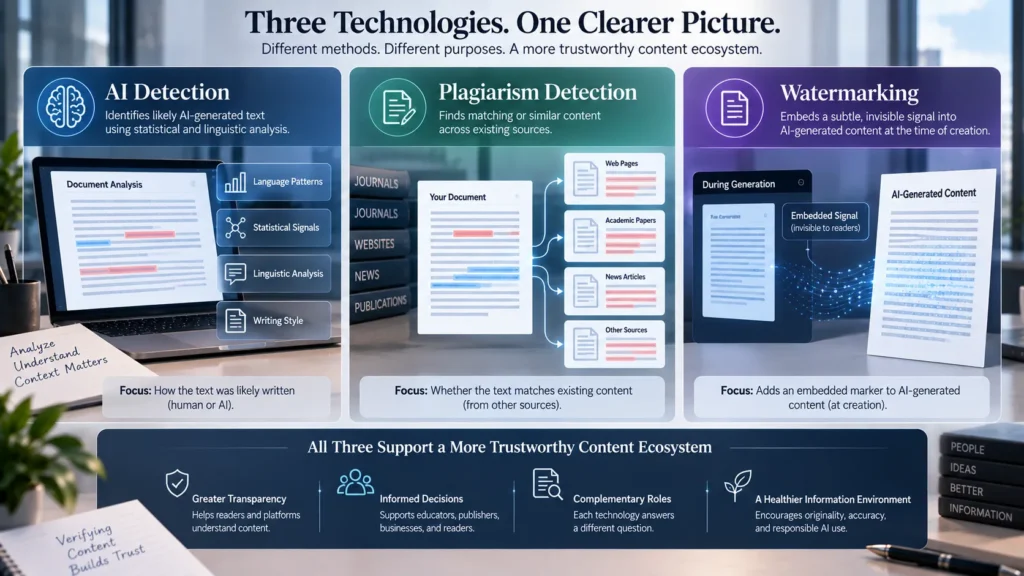
A document can be:
- original but AI-generated
- human-written but plagiarised
- AI-assisted but substantially rewritten by a person
- completely human-written and still incorrectly flagged by a detector
That is why a complete content-review process may use several types of evidence rather than relying on one score.
What AI Detectors Cannot Reliably Tell You?
An AI detector generally cannot establish all of the following from a score alone:
Who physically typed the document.
Which AI model, if any, produced a passage.
What percentage of the words were actually written by AI.
Whether AI use violated a particular policy.
Whether the writer intended to deceive anyone.
Whether a high score was caused by AI generation, editing, genre, language background, or other statistical characteristics.
A detector can provide a useful classification signal. It cannot replace the underlying evidence about how a document was created.
Why We Recommend Different Tools for Different Users
We do not use “best” to mean the highest single percentage displayed by a vendor.
Our recommendations consider the trade-off between detection capability and the consequences of false positives.
Pangram: chosen where conservative review and interpretability are more important than aggressive classification.
GPTZero: chosen for education workflows and writing-process evidence.
Copyleaks: chosen for organisations that need multilingual detection, plagiarism workflows, integrations, and scalable review.
Originality.ai: chosen for publishers and agencies that need broader content-quality workflows and hybrid AI-use controls.
Winston AI: chosen for document-heavy and OCR workflows.
ZeroGPT: chosen for simple, fast screening.
QuillBot: chosen for free detection inside a wider writing workflow.
This approach means two tools can produce different scores on the same document and still be the better choice for different users.
Frequently Asked Questions About AI Detection
Why can’t students always see a Turnitin AI score before submitting an assignment?
Turnitin’s student and instructor experiences can differ depending on the institution, product configuration, and submission workflow. Students should check their institution’s current policy rather than assuming that the AI-detection information visible to an instructor will also appear in the student account.
A plagiarism similarity percentage and an AI-writing classification are separate forms of analysis.
What is the best free AI detector in 2026?
There is no universally most accurate free AI detector for every type of writing.
QuillBot currently offers a free AI Detector with up to 1,200 words per scan and six scans per day. GPTZero offers an education-focused free plan with up to 10,000 words per month. Pangram currently offers up to 2,000 free words per day.
The better question is which tool fits your use case and has an acceptable false-positive risk.
How accurate are AI detectors in 2026?
AI-detector performance varies considerably by tool, model, document type, and testing conditions.
The University of Florida’s 2026 research found false-positive rates ranging from 0.05% to 68.6% and false-negative rates from 0.3% to 99.6% across the commercial detectors studied.
Independent testing also shows that detector performance can change when AI-generated text is edited, paraphrased, or mixed with human writing. For that reason, there is no single accuracy percentage that applies to every document.
Can an AI detector flag human-written text?
Yes. False positives are a documented limitation of AI detectors.
Human writing can contain statistical patterns that resemble those found in AI-generated text, particularly in formal, highly structured, or multilingual writing. The risk varies by detector and dataset, which is why an AI score should not be treated as standalone evidence of authorship.
Can AI detectors detect ChatGPT, Claude, Gemini, and other AI models?
Many commercial detectors are designed to identify text associated with major generative AI models, but performance is not constant across models or writing conditions.
A detector may identify clean, unedited AI output more easily than text that has been manually revised, paraphrased, mixed with human writing, or generated under different prompting conditions.
The safest interpretation is therefore that a detector estimates AI-like characteristics rather than proving which model produced the text.
Is an AI detector score proof of academic cheating?
An AI detector score should not be treated as conclusive proof of authorship or academic misconduct.
Academic policies and legal standards differ by institution and jurisdiction. For high-stakes decisions, the detector result should be considered alongside the document’s revision history, source trail, writing process, applicable policy, and human review.
University of Florida researchers have specifically raised concerns about using commercial AI detectors for high-stakes academic or disciplinary decisions because of their inconsistent false-positive and false-negative performance.
Can Grammarly or other writing assistants affect AI detector results?
It depends on what the writing assistant changes.
Basic spelling, punctuation, or formatting corrections are different from rewriting complete sentences or paragraphs. More substantial automated rewriting can change the statistical characteristics of a passage and therefore may change how an AI detector classifies it.
For that reason, do not assume that every editing action will produce the same detector result.
AI Tools & Software
Explore More AI Tools
Still comparing AI tools for your workflow? Browse our AI tools directory to discover additional AI software by category and use case.
Research, Sources, and Methodology Notes
This review combines three types of evidence:
Product information: current vendor documentation for pricing, usage limits, features, supported languages, and integrations.
Independent research: academic studies and third-party benchmarks evaluating AI-detector performance and false-positive risk.
Hands-on testing: our own September 2026 test results using the methodology described above.
Because AI detection is a rapidly changing field, product capabilities and detector performance can change after publication. Readers should use the test date and source links to understand the context of each result.
Where a vendor’s claim differs from an independent result, we identify the difference rather than presenting the vendor figure as an independently verified accuracy rate.
Writtern By: