
AI search is changing how people discover websites, compare products, and find answers. Instead of browsing ten blue links, users may ask Google AI Mode, ChatGPT, or Perplexity to summarize a topic and recommend useful sources.
For website owners, that creates a new challenge: content needs to be discoverable in traditional search and useful enough to be referenced in AI-generated answers.
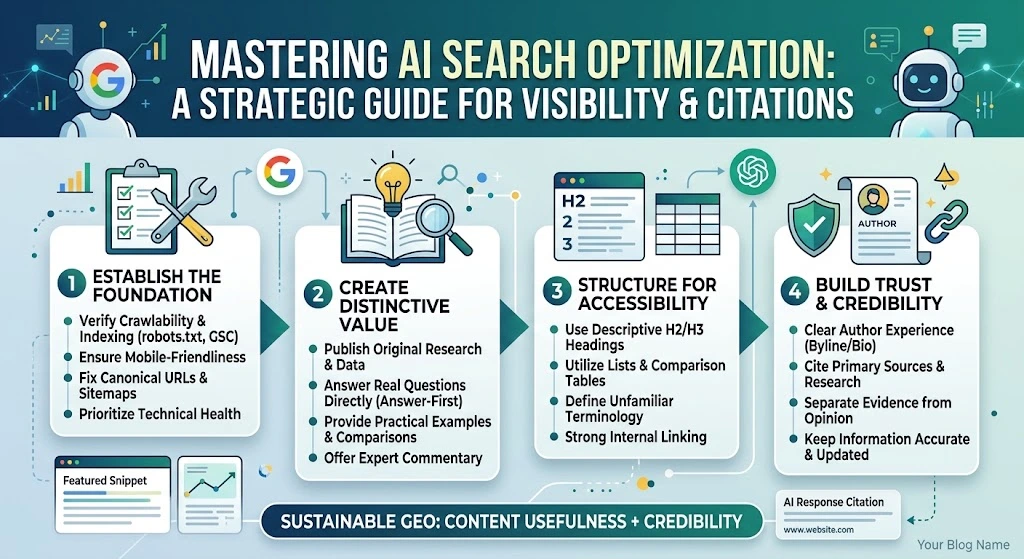
Learning how to optimize content for AI search starts with a simple principle: publish reliable information that answers real questions, make your website accessible to search systems, and build a reputation that people can verify. You do not need to abandon traditional SEO or follow every new GEO trend.
This guide explains how to optimize existing pages, improve your chances of earning relevant citations, prioritize fixes, and measure progress without relying on unsupported promises.
What Is AI Search Optimization?
AI search optimization is the process of improving your website’s technical accessibility, content quality, and online credibility so that your pages can be discovered and used in AI-powered search experiences.
Related terms include:
- Generative engine optimization (GEO): Improving the likelihood that content and brand information are referenced in generative AI responses.
- Answer engine optimization (AEO): Making information easy to use in direct answers, featured snippets, and answer-focused search experiences.
- AI SEO: Applying established SEO principles while accounting for search experiences powered by artificial intelligence.
These terms overlap, and there is no single universal GEO formula. Google explicitly says that its existing SEO practices remain relevant to its generative AI search features. Its guidance emphasizes helpful, distinctive content and sound technical foundations rather than special optimization tricks.
Read Google’s official guide to AI search optimization before implementing platform-specific recommendations.
1. Fix Technical Issues Before Rewriting Content
Before learning how to optimize content for AI search engines, confirm that search systems can access the pages you want to be discovered.
Even an excellent article cannot contribute to search visibility if it is blocked, unavailable, or excluded from the relevant index.
Check these technical SEO essentials
Crawlability: Review your robots.txt file and ensure it does not unintentionally block important pages or resources.
Indexing: Use Google Search Console’s URL Inspection tool to check whether priority pages are indexed and identify indexing problems.
Canonical URLs: Confirm that the canonical tag points to the preferred version of each page, especially when similar URLs exist.
Internal linking: Link related articles and important service pages from relevant pages. Use descriptive anchor text so readers can understand the destination.
XML sitemap: Keep your sitemap updated with canonical URLs that you want search engines to discover.
Mobile experience: Ensure that the main content remains accessible on mobile devices and that intrusive elements do not prevent visitors from reading it.
JavaScript rendering: Check that important text and links are available to search systems after rendering, rather than existing only in inaccessible client-side elements.
Check access for different AI platforms
Search engines and AI services do not necessarily use the same crawlers or access rules.
For example, OpenAI documents OAI-SearchBot as a crawler used to surface websites in ChatGPT search. It is separate from GPTBot, which relates to potential model training use. A website can configure these controls independently.
Review the official OpenAI crawler documentation before changing your robots rules.
Similarly, consult Perplexity’s crawler documentation for its published access guidance. Do not assume that allowing one crawler automatically permits every other service to access your pages.
Action: Make a short technical audit of your five most important URLs first. Fix access, indexing, canonicalization, and internal-linking problems before investing heavily in content revisions.
2. Publish Information That Adds Something New
A major part of how to optimize content for AI search is giving readers information that is more useful than a collection of familiar statements.
AI-generated answers can summarize common knowledge. Your page therefore needs a clear reason to be included as a source.
Useful differentiators include:
- Original research, surveys, or data that you can explain and substantiate.
- Detailed comparisons based on transparent criteria.
- Examples that show how a recommendation works in practice.
- Expert commentary supported by relevant experience.
- Screenshots, calculations, templates, or decision-making frameworks.
- Clear explanations of limitations, trade-offs, and exceptions.
For example, an article about AI SEO tools should do more than list popular platforms. It could compare their supported workflows, pricing models, integrations, reporting features, and ideal users. If you test the tools, explain the test conditions. If you rely on official documentation, say so rather than implying firsthand testing.
Google’s AI optimization guidance emphasizes creating valuable, distinctive content for people. That is a stronger foundation than publishing another generic article solely because a keyword has search volume.
How to improve an existing article
Ask four questions:
- What does this page explain that competing pages do not?
- Which claims need a source, calculation, example, or qualification?
- What practical question would remain unanswered after reading it?
- Can a reader make a better decision because of this page?
If your content cannot answer these questions convincingly, adding more keywords is unlikely to solve its main weakness.
3. Structure Content Around Clear Questions and Answers
A well-organized page helps readers find information quickly. It also makes individual sections easier to understand when search systems retrieve relevant passages.
However, there is no universal requirement to use a particular paragraph length or divide every page into tiny sections. Google specifically cautions against treating artificial content chunking as a special requirement for its AI search features.
Use an answer-first structure
Begin each major section with a direct response to the question raised by its heading. Then explain the reasoning, supporting evidence, and practical implications.
For example:
Weak opening:
There are many factors to consider when thinking about whether your website might benefit from optimization for new search technologies.
Stronger opening:
AI search optimization begins with accessible pages, useful original content, and credible supporting information. Start by checking indexing and then improve the pages that answer your audience’s most important questions.
The second version gives readers the main point immediately without removing the context they may need.
Make the page easy to navigate
Use:
- Descriptive H2 and H3 headings.
- Numbered steps for processes.
- Bulleted lists for related considerations.
- Comparison tables when readers need to evaluate several options.
- Definitions for unfamiliar terminology.
- Relevant internal and external links.
- Examples that clarify abstract advice.
Tables are useful when they make relationships easier to compare. Do not remove them based on the unsupported assumption that AI systems cannot understand tabular content.
Planning your next article? Use our AI Blog Outline Generator to create a clear, SEO-friendly content structure before you start writing.
4. Strengthen Evidence, Authorship, and Trust
Understanding how to optimize content for AI search also means making it easy to assess the reliability of your information.
Trust is not established by inserting an author bio or adding a few external links alone. It comes from the consistency of the evidence, the accuracy of the claims, and the credibility of the publisher.
Apply these editorial checks
Identify the author. Provide a clear byline and a useful author profile. Explain relevant experience or expertise without exaggerating credentials.
Cite primary sources. When discussing a search engine’s requirements, link to its official documentation. When presenting research, link to the original study or dataset whenever possible.
Separate evidence from opinion. Explain whether a statement comes from official guidance, a published study, your own analysis, or a recommendation.
Update changing information. Review claims about features, prices, tools, policies, and technical requirements when they are likely to change.
Correct errors. If a claim is outdated or unsupported, revise or remove it. Do not preserve it simply because it attracts traffic.
Demonstrate real experience accurately. If you conducted a test, describe the method and limitations. If you did not test a product, do not write as though you did.
These practices help readers evaluate your content and give search systems clearer information about what the page claims and why.
5. Optimize for Different AI Search Experiences
There is no single checklist that guarantees visibility across every AI platform. Different services have different interfaces, retrieval systems, policies, and ways of presenting sources.
Use platform-specific checks while maintaining a consistent foundation of quality.
Google AI Overviews and AI Mode
Start with Google’s standard technical and content requirements. Make sure the page can be crawled and indexed, and ensure that its main information is helpful, distinctive, and relevant.
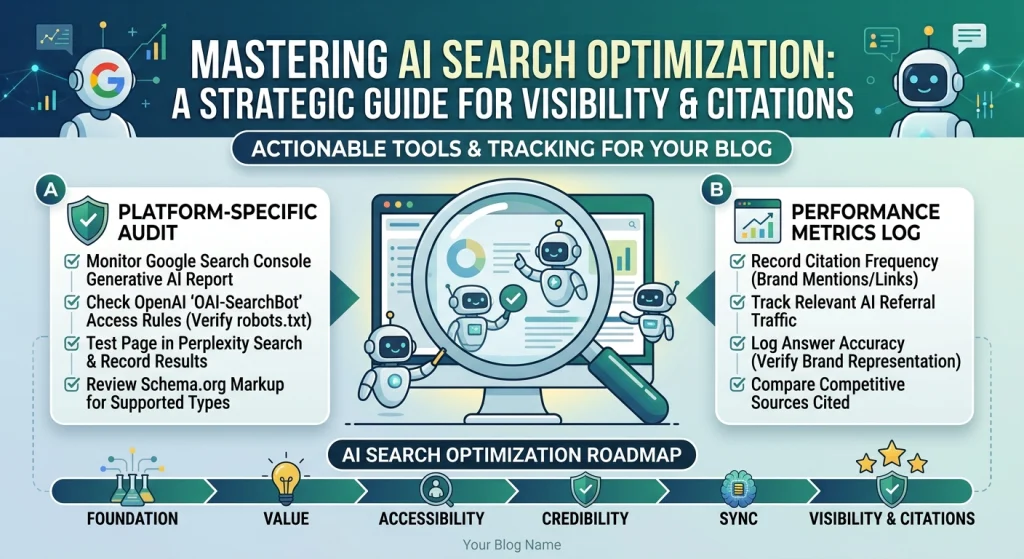
Use Google Search Console to investigate search performance. Where available, review the Generative AI performance report to examine impressions from supported generative AI features, the pages receiving them, and relevant geographic or device information.
Do not assume that indexing guarantees inclusion in an AI answer.
ChatGPT search
Review OpenAI’s published crawler guidance and decide whether your website should allow OAI-SearchBot. Make sure the pages you want discovered are publicly accessible and contain accurate, useful information.
Track relevant citations and referrals where data is available. Do not confuse access for ChatGPT search with permission for model training, because OpenAI documents these controls separately.
Perplexity
Check the published guidance for Perplexity’s crawler, then monitor whether your relevant pages appear in answers to representative queries.
Focus on useful explanations, verifiable claims, and sources that support the specific question being asked. Do not treat one successful citation as proof that a page will be cited consistently.
Other AI assistants
For other platforms, check their current documentation instead of assuming they follow Google’s, OpenAI’s, or Perplexity’s rules.
The practical goal is to make your content accessible, understandable, and worth referencing, not to produce a separate version of every article for every AI service.
6. Worked Example: Improve an Article About AI SEO Tools
Consider an article titled “How to Choose the Right AI SEO Tool.” Its purpose is to help readers compare software and select a tool that fits their needs.
The page already explains what AI SEO tools do, but it offers little help with the actual buying decision.
Step A: Identify the gaps
| Current issue | Recommended improvement | Why it matters |
|---|---|---|
| Generic introduction | Answer the selection question directly | Helps readers understand the page’s purpose |
| Tool list without criteria | Compare use cases, pricing, integrations, and limitations | Makes the advice actionable |
| Unsupported claims | Add official documentation or verified evidence | Improves credibility |
| No audience segmentation | Separate recommendations by team size and workflow | Matches more specific user needs |
| Outdated product details | Recheck current features and prices | Reduces misleading information |
| Few useful internal links | Link to relevant AI tool guides | Helps readers explore related topics |
Step B: Rewrite the introduction
Before:
AI SEO tools are becoming increasingly popular as more businesses adopt artificial intelligence. There are many tools available, and choosing the right one can be difficult.
After:
The right AI SEO tool depends on the work you need it to perform. Content teams may prioritize research and optimization, while technical SEO teams may need crawling and auditing features. Compare tools against your workflow, budget, integrations, and reporting needs before choosing one.
The revised introduction answers the decision-making question, identifies meaningful differences between users, and sets expectations for the comparison.
Step C: Add a practical selection framework
Ask readers to score each shortlisted tool against five criteria:
- Core use case: Does it solve a real problem in your workflow?
- Evidence quality: Can you verify its recommendations?
- Integration: Does it work with your existing publishing and analytics systems?
- Cost: Is the price justified by the features you will actually use?
- Limitations: What tasks still require manual review or another tool?
If the article includes prices or feature comparisons, verify them against current product documentation before publication. The example illustrates an editorial improvement process; it does not claim that the revisions produced measured traffic or citation gains.
7. Prioritize Improvements by Impact and Effort
Not every optimization deserves immediate attention. A repeatable priority system helps teams address significant problems before spending time on minor formatting changes.
Use a simple scoring model:
Priority score = estimated impact ÷ estimated effort
Rate each factor from 1 to 3. These scores are planning estimates, not measured predictions of ranking or AI citation outcomes.
| Task | Impact | Effort | Score | Suggested priority |
|---|---|---|---|---|
| Fix an important page blocked from indexing | 3 | 1 | 3.0 | Immediate |
| Correct unsupported or outdated claims | 3 | 1 | 3.0 | Immediate |
| Add a missing comparison or worked example | 3 | 2 | 1.5 | High |
| Improve confusing headings and internal links | 2 | 1 | 2.0 | High |
| Launch a broader digital PR campaign | 2 | 3 | 0.7 | Longer term |
Adjust these estimates for your own site. For instance, a page with no conversions may not deserve the same immediate attention as a high-value product page, even if both have similar technical issues.
The best workflow starts with critical access and accuracy problems, moves to high-value content improvements, and then expands into longer-term authority building.
8. Measure AI Search Visibility With a Repeatable Process
You cannot improve performance reliably if you change the content, change the test queries, and change the measurement method every time you review it.
A consistent measurement process makes results easier to interpret.
Build a baseline
Choose 10 to 20 representative prompts from your audience’s real questions. Include informational, comparison, and purchase-related queries where relevant.
For each prompt, record:
- Exact prompt and date tested.
- Platform and relevant settings.
- Whether your brand or page appears.
- Whether the response links to your page.
- Which competing sources appear.
- Whether the description of your brand is accurate.
- Any relevant referral traffic or conversions.
AI responses can vary across time, accounts, locations, and prompt wording. A single result is not enough to establish a trend.
Run a monthly review
Week 1: Establish the baseline. Run the same prompts and record the results.
Week 2: Find content gaps. Identify missing answers, weak evidence, technical problems, or competitors cited for useful information you do not provide.
Week 3: Make focused changes. Improve a defined group of pages rather than rewriting the entire website at once.
Week 4: Retest consistently. Reuse the same prompts and settings, then document what changed. Treat the findings as directional evidence, not proof that one edit caused a particular result.
Track more than citations
Citations matter, but they are not the only measure of success. Also monitor relevant organic clicks, impressions, qualified leads, conversions, and referral traffic.
Google’s Generative AI performance report documentation describes the available Google Search generative AI reporting. Third-party AI visibility tools can supplement this data, but their estimates should not be confused with official platform reporting.
9. GEO Myths That Can Waste Your Time
Some recommendations are repeated so often that they begin to sound like requirements. Check the evidence before implementing them.
Myth 1: Every page needs special AI schema.
Structured data can help search engines understand eligible content, but there is no universal AI citation schema that guarantees inclusion. Use relevant, supported schema accurately and follow the relevant platform’s documentation.
Myth 2: Every article must be divided into tiny chunks.
Clear headings and logical sections help people navigate content, but arbitrary chunk sizes are not a universal Google AI optimization requirement.
Myth 3: Adding llms.txt guarantees AI visibility.
Do not treat an optional or emerging convention as a substitute for crawlability, useful content, and established SEO practices.
Myth 4: Keyword density guarantees citations.
Repeating a phrase cannot compensate for missing information, weak evidence, or a page that does not answer the question.
Myth 5: Traditional SEO no longer matters.
Google explicitly states that its established SEO practices remain relevant to its generative AI search experiences. Continue improving technical SEO, content quality, and site structure.
Final AI Search Optimization Checklist
Before publishing or updating a page, confirm that:
- The page is accessible and eligible for relevant search features.
- The introduction answers the main question directly.
- Headings describe the information in each section.
- Claims are accurate and supported where necessary.
- The page includes original analysis, examples, or useful detail.
- Author and publisher information is clear and truthful.
- Relevant internal links help readers continue their research.
- Structured data, if used, is supported and accurate.
- Important platform-specific crawler rules have been reviewed.
- A repeatable process exists to monitor visibility and outcomes.
Conclusion
The most sustainable way to optimize content for AI search is to make your website technically accessible, your information genuinely useful, and your claims easy to verify. Clear structure helps readers, original analysis gives them a reason to choose your page, and consistent measurement helps you identify what deserves improvement.
Treat GEO as an extension of a strong content and SEO strategy, not a collection of shortcuts. Start with your most important pages, fix meaningful problems, and use evidence to guide each next step. Visibility in AI search cannot be guaranteed, but a disciplined process gives your content a stronger foundation for discovery across changing search experiences.
What is the best way to optimize content for AI search?
Start by ensuring important pages are accessible and indexable. Then provide useful, distinctive answers, support claims with credible sources, and measure visibility using consistent queries and reporting.
How do I get my website cited by AI search engines?
There is no guaranteed method. Publish information worth referencing, make the page accessible, answer the user’s question clearly, and build credible signals around your expertise. Track citations over time rather than relying on one result.
Is GEO different from traditional SEO?
GEO focuses on visibility within generative AI answers, while traditional SEO focuses more broadly on search discovery and performance. Their practices overlap substantially, especially around technical accessibility, relevance, useful content, and credibility.
Does schema markup help with AI search?
Relevant structured data can help search engines interpret eligible page information, but it does not guarantee citations. Implement supported schema that accurately represents the visible content.
How can I track AI search visibility?
Use platform reporting where available, monitor relevant referrals and conversions, and test a consistent set of prompts on selected AI platforms. Record sources, mentions, dates, and changes in a repeatable log.
