
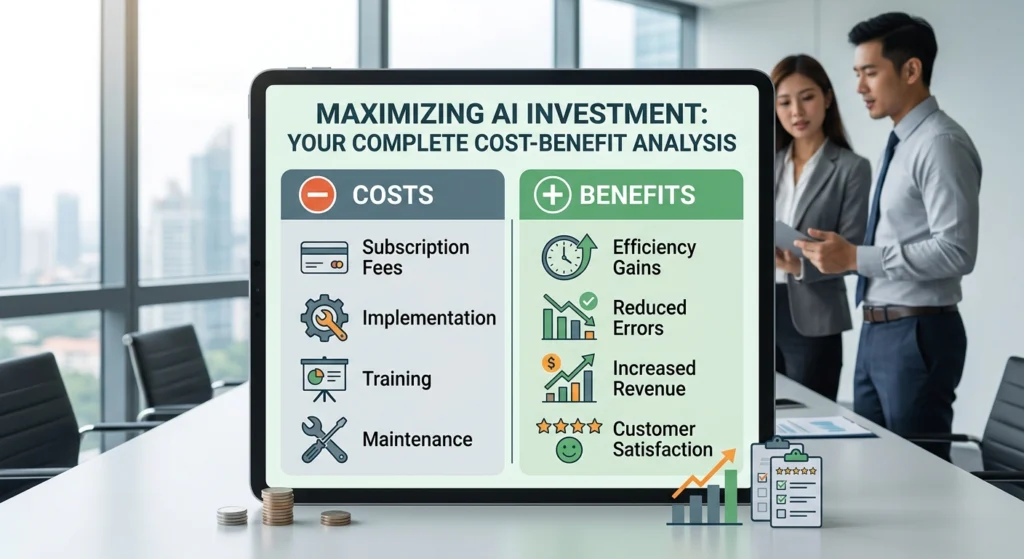
Buying an AI tool can take minutes. Proving that it is actually worth the money is much harder. A subscription may look inexpensive, but the real investment can include implementation, employee training, usage fees, integration, human review, and ongoing maintenance.
That is why an AI cost-benefit analysis should look beyond the monthly subscription price. Businesses need to compare the complete cost of an AI tool with the financial, operational, and strategic value it creates.
A useful AI cost-benefit analysis also needs a baseline. Without knowing how much a process costs before AI, it is difficult to prove how much improvement the technology has actually delivered.
What Is AI Cost-Benefit Analysis?
An AI cost-benefit analysis compares the total cost of an AI investment with the benefits expected or achieved from using it.
Those costs can include:
- AI software or subscription fees
- API and usage costs
- Implementation and integration
- Employee training
- Data preparation
- Human review and editing
- Maintenance and support
- Governance and compliance
- Opportunity costs
Benefits can include lower operating costs, time savings, fewer errors, faster processes, increased revenue, improved customer experience, and greater employee capacity.
The goal is not simply to prove that AI is useful. The goal is to determine whether its measurable value justifies the investment.
NIST’s AI Risk Management Framework similarly emphasizes measuring and monitoring AI systems using appropriate metrics, benchmarks, and ongoing evaluation rather than relying on assumptions about performance.
Why Is AI ROI Difficult to Measure?
The challenge with AI cost-benefit analysis for business is that not every benefit appears directly on a financial statement.
Suppose an AI writing tool saves an employee 10 hours each month. That does not automatically mean the business saved the employee’s hourly salary. If the employee uses those hours to produce more work, the benefit is better described as increased capacity.
That distinction matters when calculating AI return on investment.
AI value can generally fall into four categories:
- Direct savings: Spending actually decreases.
- Capacity value: Employees complete more valuable work with the same resources.
- Revenue value: AI contributes to additional sales or revenue.
- Strategic value: AI improves agility, customer experience, risk management, or competitiveness.
A strong AI cost-benefit analysis should keep these categories separate instead of treating every productivity gain as cash savings. NIST’s AI Risk Management Framework recommends using appropriate metrics to measure and evaluate AI systems, including their benefits, risks, and real-world impacts. This supports the need for an AI cost-benefit analysis that looks beyond simple output or activity metrics and considers how the technology performs in its actual business context.
Step 1: Establish Your Pre-AI Baseline
Before calculating AI tool ROI, record what the process costs without the tool.
Measure factors such as:
- Hours spent per task
- Cost per task
- Error or correction rate
- Output volume
- Turnaround time
- Revenue generated
- Employee utilization
- Customer response time
For example, if a marketing team spends 100 hours each month creating and editing content, that becomes the baseline. After introducing an AI tool, the same measurements can show whether productivity actually improved.
This is one of the most important steps in an AI investment analysis because measuring only the post-AI result makes attribution difficult.
Step 2: Calculate the Real AI Tool Cost
The subscription price is only one part of AI total cost of ownership.
Your AI implementation cost may include integration, setup, training, configuration, and data preparation. Recurring AI costs can include subscriptions, API calls, token usage, inference, support, maintenance, monitoring, and additional user seats.
A practical AI cost-benefit analysis should divide costs into two groups.
One-time costs
These may include:
- Setup
- Integration
- Data migration
- Initial training
- Custom development
Recurring costs
These may include:
- Monthly or annual subscriptions
- Usage-based charges
- API costs
- Maintenance
- Employee support
- Quality control
- Governance
Do not forget hidden AI costs. Human review, editing, fact-checking, rework, troubleshooting, and switching between vendors can materially change the economics.
Step 3: Measure the Benefits That Actually Matter
The next stage of an AI cost-benefit analysis is quantifying benefits.
For cost savings, use:
AI cost savings = Previous process cost − New process cost
For productivity gains, calculate the value of time released from the process. But make sure that time has a real business use.
For revenue impact, avoid assigning all additional revenue to AI unless there is a defensible connection between the tool and the result.
Useful AI success metrics can include:
- Cost per completed task
- Hours saved
- Error reduction
- Output per employee
- Conversion rate
- Revenue per employee
- Customer response time
- Customer retention
- Accepted AI outputs
Productivity Gains Are Not Always Cash Savings
This is where many AI ROI calculations go wrong.
If an AI tool saves 20 employee hours but staffing levels remain unchanged, the business may have gained capacity rather than reduced costs.
That capacity still has value, but it should be reported honestly.
A stronger model separates:
Hard savings from capacity value.
This prevents an AI business case from overstating its financial return.
Step 4: Include Human Review and Quality Costs
An AI tool may produce an answer in seconds, but that does not mean the answer is ready for use.
Employees may need to:
- Check facts
- Edit language
- Verify sources
- Correct errors
- Review compliance
- Rewrite poor outputs
- Approve final content
These activities create an AI human review cost.
You can also use a quality-adjusted approach:
Quality-adjusted benefit = Gross benefit × usable-output rate
If an AI tool generates 100 outputs but only 80 are usable without significant correction, the business should not value all 100 outputs equally.
This is especially important for content creation, coding, research, customer support, and other workflows where inaccurate AI output can create additional work.
NIST’s measurement guidance emphasizes evaluating AI in context and continuing measurement as systems and operating environments change.
Step 5: Measure Adoption and Utilization
An AI tool cannot generate its potential ROI if employees barely use it.
Track:
- Adoption rate
- Active users
- Usage frequency
- Seat utilization
- Tasks completed with AI
- Percentage of eligible workflows using AI
This creates a useful distinction between potential value and realized value.
Realized AI value = Potential value × Adoption rate
If a company purchases 20 seats but only 10 employees actively use the software, the investment should be evaluated based on actual utilization rather than the number of licenses purchased.
This makes adoption an important part of AI performance measurement.
Step 6: How to Calculate AI ROI
The standard AI ROI formula is:
AI ROI = (Total Benefits − Total Costs) ÷ Total Costs × 100
Consider an AI tool costing $100 per month.
If it creates $600 in measurable monthly value but requires $120 in additional human review and quality control, the net benefit is $380.
The calculation becomes:
($380 − $100) ÷ $100 × 100 = 280% ROI
This is a simple example, but it demonstrates why a good AI cost-benefit analysis must include more than the subscription price.
Step 7: Calculate Payback and Break-Even
ROI tells you whether an investment creates value. The AI payback period tells you how quickly the investment recovers its cost.
A simple calculation is:
Payback period = Initial investment ÷ Monthly net benefit
You can also calculate the AI break-even point for usage-based tools.
Break-even usage = Monthly tool cost ÷ Value per successful task
For example, if an AI tool costs $200 per month and each successfully completed AI-assisted task creates $10 of measurable value, the business needs about 20 successful tasks per month to cover the subscription.
This makes AI payback calculation especially useful when comparing different pricing models.
Step 8: Compare AI Tools by Total Value
An AI tool comparison should never focus only on price.
When comparing Tool A and Tool B, consider:
| Metric | Tool A | Tool B |
|---|---|---|
| Monthly cost | $100 | $160 |
| Estimated adoption | 80% | 90% |
| Review time | Higher | Lower |
| Successful output rate | 75% | 90% |
| Estimated monthly value | $500 | $700 |
| Net monthly benefit | $325 | $420 |
Tool B costs more, but it may generate greater value.
This is why AI tool ROI comparison is more useful than choosing the cheapest subscription.
Businesses should also consider vendor lock-in, contract terms, data requirements, pricing changes, integration limitations, and switching costs. If you are comparing different AI solutions, start by looking beyond subscription prices and evaluate each tool’s features, use cases, capabilities, and business value. A structured AI tool comparison can help you narrow the options before calculating the potential return on investment.
Step 9: Use Conservative, Realistic, and Optimistic Scenarios
No AI cost-benefit analysis should depend on a single forecast.
Build at least three scenarios:
Conservative: Lower adoption, higher review costs, lower productivity gains.
Realistic: Expected adoption and performance based on available evidence.
Optimistic: Strong adoption, higher productivity gains, and favorable operating conditions.
Scenario analysis makes an AI investment decision more resilient because it shows what happens when assumptions change.
It can also expose AI ROI risk, including cost escalation, low adoption, unexpected maintenance, vendor changes, or regulatory requirements.
Step 10: Know When AI Is Not Worth the Cost
A credible AI cost-benefit analysis should be willing to conclude that an AI tool is not worth buying.
An AI investment may not make sense when:
- The process is already inexpensive
- Employees rarely perform the task
- Review costs cancel out time savings
- Adoption is expected to remain low
- The tool creates significant quality problems
- Integration costs are excessive
- A simpler non-AI solution works better
- The expected payback period is too long
The right question is not “Can AI improve this process?”
It is:
“Can this AI solution create enough reliable business value to justify its total cost?”
Keep Measuring After the Purchase
An AI cost-benefit analysis should not end when the purchase is approved.
Track performance after deployment and compare actual results with the original baseline.
Monitor:
- Actual usage
- Actual costs
- Productivity changes
- Output quality
- Error rates
- Business outcomes
- Adoption
- Payback progress
NIST recommends ongoing measurement and monitoring because AI performance, risks, and operating conditions can change after deployment.
That makes ROI measurement an ongoing management process rather than a one-time justification exercise.
AI Cost-Benefit Analysis Checklist

Before approving an AI investment, ask:
- What does the process cost today?
- What is the complete AI total cost of ownership?
- Which costs are one-time and which are recurring?
- What benefits can be measured financially?
- Which benefits represent capacity rather than cash savings?
- How much human review is required?
- What adoption rate is realistic?
- What is the expected payback period?
- What is the break-even usage level?
- What happens under conservative assumptions?
- How does the tool compare with alternatives?
- What happens if the tool is discontinued?
If these questions have clear answers, the resulting AI business case will be much more credible.
The Bottom Line
The best AI cost-benefit analysis does more than compare a subscription fee with estimated productivity gains. It establishes a pre-AI baseline, calculates the full cost of ownership, measures real business outcomes, accounts for quality and human review, tracks adoption, and tests different scenarios.
That approach makes AI return on investment easier to defend and easier to improve.
Ultimately, the most valuable AI tool is not necessarily the cheapest or the most powerful. It is the one that creates reliable, measurable business value that exceeds its total cost.
What is AI cost-benefit analysis?
AI cost-benefit analysis compares the total costs of an AI investment with its measurable financial, operational, and strategic benefits.
How do you calculate AI ROI?
Calculate AI ROI by subtracting total AI costs from total benefits, dividing by total costs, and multiplying by 100.
What costs should be included in AI ROI?
Include subscription, implementation, integration, training, usage, maintenance, human review, and other ongoing AI costs.
How do you know if an AI tool is worth the cost?
Compare its total cost with measurable savings, productivity value, adoption, output quality, payback period, and business outcomes.
