
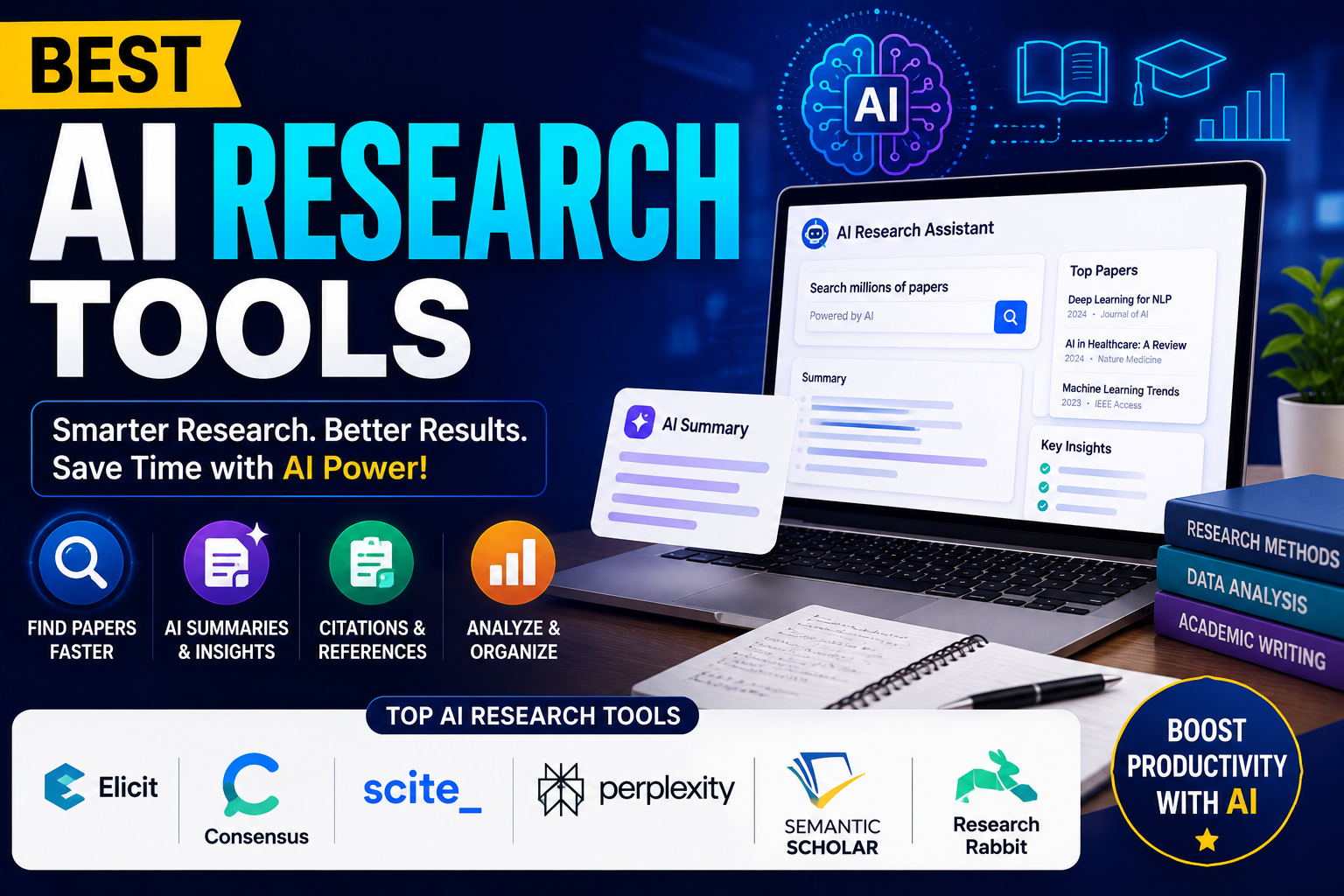
Discover the Best AI Tools for Smarter Research
Research can be time-consuming, especially when you need to read multiple papers, analyze data, summarize documents, and verify sources. Fortunately, AI research tools are transforming the way students, researchers, professionals, and businesses gather information.
From finding academic papers to summarizing lengthy documents and organizing references, AI-powered research tools help users save time while improving the quality of their work.
In this article, we’ll explore the best AI research tools available in 2026, including their features, advantages, disadvantages, pricing, and ideal use cases.
What Are AI Research Tools?
AI research tools use artificial intelligence to help users search for information, summarize articles, analyze documents, organize references, and answer research-related questions.
These tools are useful for:
- Academic research
- Business research
- Market analysis
- Literature reviews
- Scientific studies
- Content creation
- Data analysis
- Report writing
Why Use AI Research Tools?
Traditional research often requires hours of reading and organizing information. AI research assistants automate many of these tasks, allowing users to focus on understanding and applying knowledge.
Benefits
- Faster research
- Automatic summaries
- Better source discovery
- Citation assistance
- Organized notes
- Improved productivity
- AI-powered insights
- Easy collaboration
1. Elicit
Overview
Elicit is an AI-powered research assistant designed to help users find academic papers, summarize studies, and answer research questions.
Key Features
- Research paper search
- AI summaries
- Citation support
- Evidence extraction
- Literature review assistance
Pros
- Great for academic research
- Easy-to-understand summaries
- Saves significant research time
Cons
- Mainly focused on academic content
Best For
Students, researchers, and educators.
2. Consensus
Overview
Consensus helps users find scientific answers by searching peer-reviewed research papers instead of general web pages.
Key Features
- AI-powered search
- Scientific paper database
- Research summaries
- Evidence-based answers
- Quick insights
Pros
- Reliable academic sources
- User-friendly interface
- Fast search results
Cons
- Limited to scientific research
Best For
Medical researchers, scientists, and students.
3. Scite
Overview
Scite helps researchers evaluate scientific papers by showing how studies have been cited by other researchers.
Key Features
- Smart citations
- Citation analysis
- Research validation
- AI recommendations
- Paper discovery
Pros
- Excellent citation tracking
- Trusted academic database
- Improves research quality
Cons
- Advanced features require a subscription
Best For
Researchers and universities.
4. Perplexity AI
Overview
Perplexity AI is an AI-powered answer engine that provides accurate responses with source citations, making it useful for research and learning.
Key Features
- AI search engine
- Source citations
- Follow-up questions
- Fast responses
- Web-based research
Pros
- Easy to use
- Reliable sources
- Quick information gathering
Cons
- Some advanced features require a paid plan
Best For
General research, business analysis, and education.
5. Semantic Scholar
Overview
Semantic Scholar uses artificial intelligence to help users discover relevant academic papers quickly.
Key Features
- Research paper search
- AI recommendations
- Citation analysis
- Author profiles
- Academic database
Pros
- Huge collection of papers
- Free to use
- Excellent search filters
Cons
- Limited non-academic content
Best For
Academic researchers and university students.
6. Research Rabbit
Overview
Research Rabbit helps users discover related papers, authors, and research topics using visual knowledge maps.
Key Features
- Visual research maps
- Citation networks
- Collaboration tools
- Paper recommendations
- Collection management
Pros
- Innovative interface
- Easy topic discovery
- Free to use
Cons
- Learning curve for beginners
Best For
Researchers working on literature reviews.
Comparison Table
| Tool | Free Plan | AI Summary | Citation Support | Best For |
|---|---|---|---|---|
| Elicit | ✅ | ✅ | ✅ | Academic Research |
| Consensus | ✅ | ✅ | ✅ | Scientific Research |
| Scite | Trial | Limited | ✅ | Citation Analysis |
| Perplexity AI | ✅ | ✅ | ✅ | General Research |
| Semantic Scholar | ✅ | Limited | ✅ | Research Papers |
| Research Rabbit | ✅ | ❌ | ✅ | Literature Reviews |
How to Choose the Best AI Research Tool
Before selecting an AI research tool, consider:
- Research purpose
- Database quality
- Citation support
- AI summary accuracy
- Collaboration features
- Export options
- Pricing
- Ease of use
Choose the platform that best fits your academic or professional needs.
Tips for Better AI-Assisted Research
To get the best results:
- Verify AI-generated information.
- Read the original sources.
- Compare multiple references.
- Keep notes organized.
- Use trusted academic databases.
- Check publication dates.
- Review citations carefully.
Advantages of AI Research Tools
AI research tools provide many long-term benefits:
- Save research time
- Improve productivity
- Better information discovery
- Accurate summaries
- Easier literature reviews
- Organized research workflow
- Improved collaboration
- Faster report writing
Who Should Use AI Research Tools?
These tools are perfect for:
- Students
- Teachers
- University researchers
- Scientists
- Business analysts
- Content writers
- Journalists
- Consultants
- Healthcare professionals
- Market researchers
Final Thoughts
AI research tools have revolutionized the way information is collected, analyzed, and organized. Whether you’re writing a thesis, conducting market research, or preparing a business report, these tools can significantly reduce research time while improving accuracy.
Platforms like Elicit, Consensus, Scite, Perplexity AI, Semantic Scholar, and Research Rabbit each offer unique features for different types of research. Explore them and choose the one that best matches your workflow.
As AI technology continues to evolve, research tools will become even smarter, helping users discover knowledge faster and make more informed decisions.
Frequently Asked Questions (FAQs)
What is the best AI research tool?
Elicit and Perplexity AI are among the most popular AI research tools because of their AI-powered search, summaries, and citation support.
Are AI research tools free?
Many AI research tools offer free plans with basic features, while premium plans provide advanced search, collaboration, and analytics.
Can AI help with academic research?
Yes. AI research tools can find papers, summarize studies, organize references, and assist with literature reviews.
Which AI research tool provides citations?
Consensus, Elicit, Perplexity AI, Scite, and Semantic Scholar all support citations or reference tracking.
SEO Meta Title
Best AI Research Tools (2026) | Top AI Tools for Smarter Research
SEO Meta Description
Discover the best AI research tools for academic, business, and scientific research. Compare Elicit, Consensus, Scite, Perplexity AI, Semantic Scholar, and more.
Focus Keyword
Best AI Research Tools
URL Slug
best-ai-research-tools