
Creating content in 2026 means managing far more than writing. A single campaign can involve research, ideation, SEO, articles, graphics, video, social media, email, editing, repurposing, and publishing.
That is why choosing the Best AI Tools for Content Creation in 2026 is less about finding one magical platform and more about finding the right tools for each stage of your workflow.
Some platforms are excellent general-purpose assistants. Others specialize in SEO, design, video, social media, research, audio, or content repurposing. The right combination can help you create faster without turning your entire workflow into automated, generic content.
Quick Answer: What Are the Best AI Tools for Content Creation in 2026?
The Best AI Tools for Content Creation in 2026 depend on what you actually produce.
| Content need | Recommended tool | Best use |
|---|---|---|
| All-around content | ChatGPT | Research, ideation, writing, editing and repurposing |
| Long-form writing | Claude | Detailed writing and context-heavy projects |
| Marketing content | Jasper | Brand and marketing workflows |
| SEO content | Surfer SEO | Search-focused planning and optimization |
| Design | Canva | Graphics, presentations, social content and visual assets |
| AI images | Midjourney | Creative image generation |
| AI video | Runway | Generative video and visual production |
| Video editing | Descript | Editing, transcription and repurposing |
| AI voice | ElevenLabs | Voiceovers and narration |
| Social content | Buffer or Predis.ai | Planning, creation and publishing |
| Research | Perplexity or NotebookLM | Research and information organization |
There is no universal winner. A blogger may need a writing assistant and SEO platform, while a YouTuber may need video, audio and thumbnail tools.
The Best AI Tools for Content Creation in 2026 are therefore the ones that solve your biggest content bottlenecks. If you want to compare more options beyond the tools covered here, explore the AI Tools Directory to discover software across writing, image generation, video, audio, coding, and other AI categories
What Are AI Content Creation Tools?
AI content creation tools use generative artificial intelligence to help create, transform, organize, optimize, or distribute content.
Depending on the platform, they can support:
- Blog posts and articles
- Website copy
- Social media posts
- Emails and newsletters
- Product descriptions
- Scripts
- Images and graphics
- Videos
- Voiceovers
- Presentations
- SEO briefs
- Content summaries
- Repurposed content
An AI content generator can accelerate production, but it does not automatically create valuable content.
Human judgment still matters for research, accuracy, originality, audience understanding, brand voice, and editorial decisions.
How We Evaluated These AI Tools
Our approach to the Best AI Tools for Content Creation in 2026 focuses on usefulness rather than simply listing popular names.
We considered content quality, format coverage, ease of use, workflow value, SEO capabilities, repurposing potential, accessibility, scalability, and common limitations.
We also considered different creator needs. A freelancer producing four articles a month should not necessarily use the same software stack as an agency managing hundreds of assets.
Tool capabilities and pricing can change quickly, so current plan details should be verified with the provider before subscribing.
Best AI Tools for Content Creation in 2026 by Use Case
1. ChatGPT: Best All-Around Choice
ChatGPT is one of the most flexible options for content creators. It can support brainstorming, research organization, outlining, drafting, rewriting, FAQs, email copy, social posts, scripts, summaries, and repurposing.
Best for: Bloggers, freelancers, marketers, small businesses, students, and creators.
Strength: Versatility across the content lifecycle.
Limitation: Strong output still depends on the quality of your instructions, source material, and editing.
For many beginners, ChatGPT is a practical starting point when exploring the Best AI Tools for Content Creation in 2026.
2. Claude: Best for Long-Form Writing
Claude is useful for projects involving substantial context, detailed instructions, source material, or long-form drafts.
It can help organize complex information, develop articles, refine writing, and work through lengthy documents.
Best for: Writers, researchers, marketers, and teams working with detailed material.
Strength: Long-form and context-heavy workflows.
Limitation: It still requires fact-checking and editorial review.
3. Jasper: Best for Marketing Teams
Jasper is designed around marketing workflows and can be particularly useful for businesses that need consistent brand-focused content.
It makes more sense for structured marketing operations than for someone who occasionally needs a blog introduction.
Best for: Marketing teams, agencies, and businesses producing content at scale.
Strength: Marketing and brand workflows.
Limitation: Individual creators may not need its broader capabilities.
4. Surfer SEO: Best for SEO Content
Surfer SEO focuses on content optimization for organic search. It can support keyword planning, content briefs, optimization, and other search-focused activities.
Best for: SEO writers, publishers, agencies, and businesses targeting organic traffic.
Strength: Search-focused content workflows.
Limitation: SEO recommendations should inform editorial decisions rather than replace them.
5. Canva: Best for Accessible Design
Canva is useful when written content needs supporting visuals. It can help create social graphics, presentations, thumbnails, documents, marketing assets, and other designs.
Best for: Small businesses, marketers, educators, creators, and social media managers.
Strength: Accessible design combined with AI-assisted features.
Limitation: Highly specialized creative work may require more advanced software.
6. Midjourney: Best for Creative Images
Midjourney is aimed at AI-generated visual creation and can help creators explore illustrations, concepts, artistic imagery, and campaign visuals.
Best for: Designers, marketers, visual creators, and storytellers.
Strength: Creative image generation.
Limitation: Brand consistency and final production may require additional editing.
7. Runway: Best for AI Video
Runway focuses on generative video and creative production. It can support creators experimenting with AI-generated footage, visual concepts, and video effects.
Best for: Video creators, marketers, and visual storytellers.
Strength: Generative video capabilities.
Limitation: Strong results still require creative direction and editing.
8. Descript: Best for Video Editing and Repurposing
Descript connects video editing with text-based workflows, making it useful for creators working with recordings, transcripts, clips, and repurposed content.
Best for: YouTubers, podcasters, educators, and marketing teams.
Strength: Text-based editing and repurposing.
Limitation: It is most useful when you already have recorded material.
9. ElevenLabs: Best for AI Voice
ElevenLabs focuses on AI-generated speech and can support narration, voiceovers, and audio versions of content.
Best for: Video creators, publishers, podcasters, and businesses.
Strength: Voice-focused production.
Limitation: Good audio still depends on strong scripts and editorial direction.
10. Buffer and Predis.ai: Best for Social Workflows
Social content involves more than generating captions. Creators need platform-specific writing, visuals, scheduling, consistency, and publishing.
Buffer and Predis.ai can support different parts of this workflow.
Best for: Social media managers, creators, small businesses, and marketing teams.
Strength: Social planning and publishing workflows.
Limitation: AI-generated posts still need brand-specific editing.
Best AI Tools for Content Creation in 2026 by Creator Type
The Best AI Tools for Content Creation in 2026 also depend on who is using them.
Bloggers
A blogger can often work efficiently with a general AI assistant, an SEO platform, and a design tool.
The workflow might be:
Research → outline → draft → SEO optimization → editing → graphic → publish → repurpose
YouTubers
YouTubers may benefit from an AI writing assistant for research and scripts, a video editor, a thumbnail tool, and an audio or transcription platform.
Freelance Writers
Freelancers generally benefit more from flexible writing, research, editing, and SEO tools than from large enterprise content platforms.
Social Media Managers
Social media professionals should prioritize platform-specific creation, scheduling, visual production, analytics, and content repurposing.
Small Businesses
Small businesses usually benefit from a compact stack rather than multiple specialist subscriptions. One general AI assistant, one design platform, and one social or SEO tool can cover a surprising amount of work.
Agencies
Agencies may need more specialized platforms because they handle multiple clients, brand voices, formats, approval processes, and publishing channels.
Choosing according to your role is one of the easiest ways to narrow down the Best AI Tools for Content Creation in 2026.
What Is the Best Free AI Content Creator?
There is no single answer because free plans vary by task, usage, and features.
General-purpose AI assistants are useful for writing and brainstorming. Canva can be a practical starting point for visual content, while specialist platforms often provide limited free access.
When comparing the Best AI Tools for Content Creation in 2026, do not look only for the word “free.”
Ask:
What can I actually create without paying?
How much usage is included?
Which important features are restricted?
Will the free version remain useful as my publishing volume grows?
A free plan can be ideal for occasional creation but restrictive for daily publishing.
Build an AI Content Workflow, Not a Tool Collection
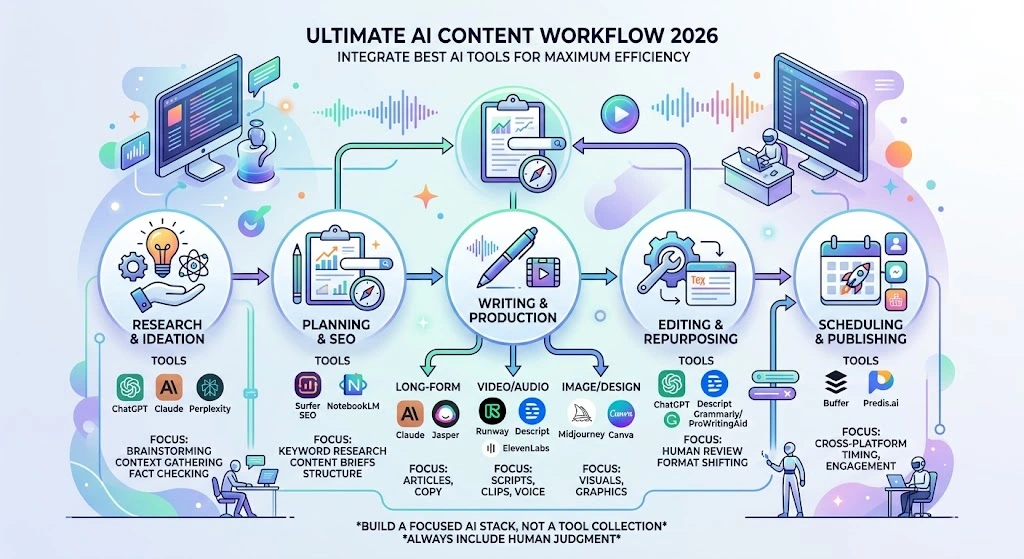
The Best AI Tools for Content Creation in 2026 become much more valuable when they work together.
A practical workflow starts with research.
Research
Understand the topic, audience, search intent, competitors, questions, and reliable sources.
Planning
Create a brief that defines the audience, goal, format, angle, key points, and desired outcome.
Drafting
Use AI to accelerate the first draft rather than treating the first generated response as the final version.
Fact-Checking
Verify statistics, dates, product claims, technical information, quotations, and other details that could damage trust if incorrect.
Optimization
Improve headings, structure, internal links, terminology, metadata, search intent, FAQs, and readability.
Human Editing
Add examples, opinions, context, specificity, originality, and brand voice.
Repurposing
One strong article can become:
Article → newsletter → LinkedIn post → social captions → video script → carousel → FAQ → video description
This is where AI-powered content creation can create genuine efficiency.
Can AI-Generated Content Rank on Google?
Yes. AI involvement alone does not determine whether content can appear in search results.
The stronger question is whether the page is useful, accurate, relevant, original, trustworthy, and aligned with what the searcher needs.
That means the Best AI Tools for Content Creation in 2026 should be used to accelerate quality, not mass-produce generic pages.
A stronger formula is:
AI assistance + human judgment + reliable research + original value + search intent + editorial review
Google’s guidance emphasizes that AI-generated content should meet the same standards for accuracy, quality, relevance, and user value as other web content. Google’s guidance on AI-generated content
How AI Supports AEO and GEO
Content now needs to work across traditional search and AI-powered discovery.
Answer Engine Optimization, or AEO, focuses on providing clear answers to questions.
Generative Engine Optimization, or GEO, focuses on improving visibility within generative search experiences.
Strong content for both should:
- Answer important questions directly.
- Use descriptive headings.
- Explain concepts clearly.
- Support important claims.
- Cover related entities naturally.
- Make useful information easy to identify.
- Demonstrate genuine expertise and usefulness.
This makes the Best AI Tools for Content Creation in 2026 valuable not only for producing text, but also for structuring information that people and AI-powered systems can understand.
How Many AI Tools Do You Really Need?
Probably fewer than you think.
A solo blogger may need:
One general AI assistant + one SEO tool + one design platform.
A YouTuber might need:
AI assistant + video editor + design tool + transcription or voice platform.
An agency may need:
Research + writing + SEO + design + video + social + analytics.
The goal is not to collect the Best AI Tools for Content Creation in 2026 simply because they exist.
The goal is to remove bottlenecks.
Every additional platform brings another subscription, workflow, login, learning curve, and opportunity for inconsistent output.
Common AI Content Mistakes
The biggest mistake is publishing AI output without meaningful human review.
Other problems include:
Skipping fact-checking: AI can produce confident but inaccurate information.
Writing only for keywords: Search optimization should support readers, not make writing unnatural.
Using identical prompts everywhere: Blog posts, LinkedIn posts, emails, videos, and product descriptions require different approaches.
Over-automating: Content can quickly become repetitive when every stage is delegated.
Ignoring originality: Repeating information competitors already provide gives readers little reason to choose your page.
Using too many tools: A complicated stack can make production slower.
Avoiding these problems matters more than finding yet another platform from a list of Best AI Tools for Content Creation in 2026.
How to Choose the Right AI Content Creation Software
Before subscribing to any platform, ask five questions.
What do I create most often?
Your needs as a blogger are different from those of a YouTuber or social media manager.
Where am I losing the most time?
If writing is slow, start with an AI writing tool. If visuals are the bottleneck, prioritize design.
Do I need a generalist or specialist?
General-purpose AI offers flexibility. Specialist platforms can provide deeper workflows.
Will I use the advanced features?
Do not pay for an enterprise platform if your actual needs are a few articles each month.
Does it fit my workflow?
The right tool should make publishing easier, not create another complicated system to manage.
Discover More AI Tools for Your Workflow
The AI landscape changes quickly. New writing assistants, image generators, video platforms, SEO tools, research applications, and creator tools appear constantly.
That means finding the right tool is not always about identifying one permanent winner.
If you know what you need to create, explore AI tools by category and compare platforms according to your format, workflow, budget, audience, and publishing goals.
The Best AI Tools for Content Creation in 2026 should help you research better, create faster, publish consistently, and deliver more useful content.
Final Verdict
The Best AI Tools for Content Creation in 2026 are not necessarily the platforms that generate the most words, images, or videos.
They are the tools that solve real production problems.
Start with one flexible AI assistant. Add an SEO, design, video, audio, research, or social platform only when you have a genuine need for it.
Most importantly, keep humans responsible for accuracy, originality, strategy, brand voice, and final editorial decisions.
AI should make good content easier to produce, not make mediocre content easier to publish.
For most creators, the smartest starting point is simple:
One general AI assistant + one specialist tool for your biggest bottleneck + one visual or publishing tool.
Build from there as your content operation grows.
What are the Best AI Tools for Content Creation in 2026?
The strongest options vary by task. ChatGPT and Claude are versatile choices, while Surfer SEO, Canva, Runway, Descript, ElevenLabs, and social platforms are better suited to specific content workflows.
Which AI is best for content writing?
ChatGPT and Claude are strong general-purpose writing options. Jasper can be useful for marketing teams with structured brand-content workflows.
What is the best free AI content creator?
It depends on the format. General-purpose AI assistants are useful for writing, while Canva is useful for visual content. Free plans should be compared based on actual usage limits and features.
What AI can create blog posts?
General-purpose AI assistants and specialist writing platforms can help with research organization, outlines, drafts, FAQs, and editing. Human research and fact-checking should remain part of the process.
