
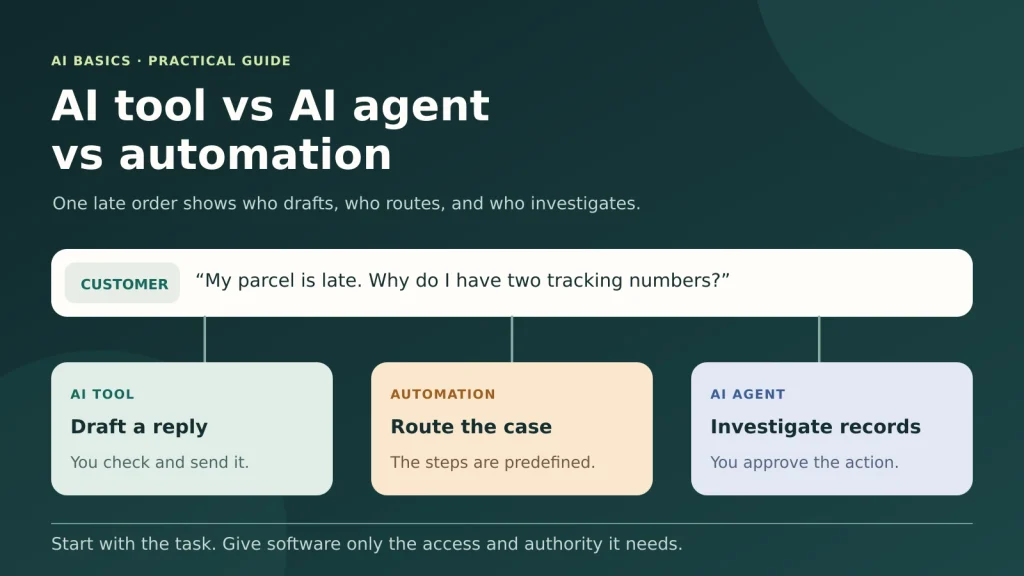
The customer complains about late delivery of the order. You can either request the software to compose a response, design a workflow for managing the complaint, or enable the system to check the delivery record. This is the moment when the distinction between the AI tools vs AI agents vs automation is needed since all these methods would take less time, but each one would provide the software with different tasks and authority.
Brief answer: AI tool helps you in accomplishing some task like composing the reply; automation executes a series of actions predefined by you in advance based on some triggering event. An AI agent takes decisions how to proceed towards achieving some goal basing on the information and instruments available to it.
Start With One Late-Order Complaint
Think about a little online store. The customer writes, “My package should have arrived yesterday. I have two tracking codes, but neither gives me information on where it is. Can I be refunded?” The ordering system says there are two packages, whereas the courier sites give different information.
The shop needs to respond to the question, find out what happened, and make decisions about it. Here is how each approach can be helpful for this question.
An AI Tool Helps Draft the Reply
The owner copies the message and sends it to a writing assistant program, requesting an acknowledgment without emotions. The program comes up with the draft, which the owner then reviews, deletes the wrong claim of delivering on time and sends the new email.
This is an example of an AI program working on one of the tasks. It may write something and summarize things, but it does not necessarily know the store’s database and does not have the authorization to offer a refund.
When Does Automation Handle the Enquiry?
The owner can define a workflow: new delivery complaint → open support ticket → include the order → note any refund requests for a manager. The workflow is executed in that order as defined by the owner. Rule-based workflows can do that without AI.
An AI step can label the message as a delivery complaint, but the subsequent flow of messages is pre-defined. In case of incorrect labeling, the wrong queue might receive the message. Workflow automation is suitable for executing repetitive steps in the process, but there should be ways to verify the process and handle exceptions. Robotic process automation is yet another method to execute repetitive steps using software.
Our AI automation guide describes the product limitations to keep in mind when selecting a workflow platform. If you’re choosing software to build that workflow, our AI automation tools guide explains the limits to check, including usage caps, pricing, and data privacy.
An AI Agent Investigates the Unusual Case
The owner instructs the agent with a clear task: to figure out why the tracking numbers differ and give a suggested solution. Based on access to the order and courier logs, it determines whether the items were sent separately, it analyzes the latest scans, and it figures out what is unclear. It may need additional information or suggests contacting the courier.
The agent decides how to proceed further based on that knowledge. This is goal-driven decision-making: the next step depends on what the agent finds. The owner may demand confirmation before it sends a message, modifies an order, or pays out. Agentic AI need not necessarily be unbound, and changing its strategy during the course of the investigation does not mean that it learns from it.
Where the Labels Can Mislead You
The AI automation vs AI agents distinction is about who chooses the next step, while an AI workflow vs AI agent comparison asks whether the path is fixed or adaptive
There is some overlap between these three terms. The term AI tool refers to a product or a capability, automation refers to a manner in which tasks are performed, and agent refers to the capability of a system to decide on actions for attaining a desired objective. A chatbot answering a question need not be an agent.
“AI Automation” may be programmed to follow a fixed procedure even when a particular stage may produce a varying answer. Similarly, “Agent” as a product may be scripted in the same way. What needs to be asked here is whether it has the ability to decide on the next move to make, which systems it can access, and approval from whom is required? That is where human approval and oversight become important.
Anthropic’s guide to building AI agents explains the distinction: workflows follow predefined paths, while agents can choose their own steps and tools as a task develops.
AI Tools vs AI Agents vs Automation: Which Fits Your Task?
| Consider | AI tool | Automation | AI agent |
| Best fit | One draft, summary, or analysis | Repeatable, predictable processes | Unusual cases that require investigation |
| Setup | A prompt and review | Triggers, rules, and connections | A goal, tools, permissions, and testing |
| Speed | Fast for a single task | Fast after initial setup | May take longer to check multiple sources |
| Running cost | Depends on usage | Depends on runs and connected tools | May rise with multiple steps and tool calls |
| Predictability | Output can vary | Steps are fixed, though an AI step’s output can vary | Next steps depend on context |
| Typical mistake | Invented or incorrect detail | Broken connection or incorrect routing | Poor decision or unnecessary action |
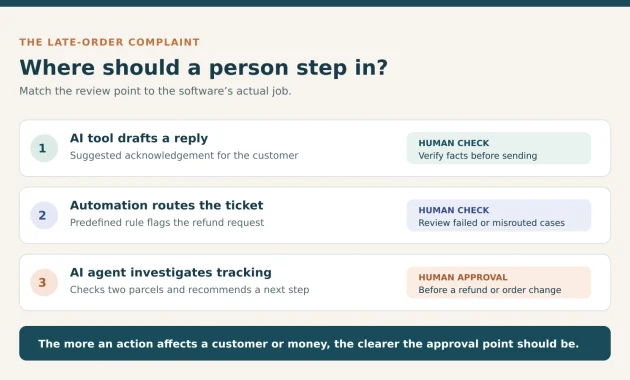
| Human oversight | Check the output | Investigate failures and exceptions | Approve critical actions and review decisions |
For AI tools vs AI agents vs automation , use the simplest one to solve your issue. For the late-order message, the solution could be in a drafted acknowledgment for today. If your shop gets tens of such messages weekly, then routing can be helpful. An agent is required when investigation of some exceptional cases requires less effort than creating an agent itself.
Test One Task Before Building a Bigger System
- Write out the task. Handle complaints correctly.
- Identify the expected process. Ticket creation and manager notification should be done systematically.
- Identify the exceptions. Tracking information conflicts might need to be looked into.
- Restrict access. Start off by giving a trial agent only read access; have authorization for any refunds and outgoing mail.
- Calculate the total output. Time spent setting up, handling each complaint, the amount of errors, corrections, and time analyzing each complaint.
Put the Three Approaches Together Only When Useful
Automation can handle the complaint, while an artificial intelligence can formulate the standard response letter. The agent can then handle the unique problem of tracking. The owner will then approve of the final decision.
This would make a better test than purchasing a product based on its label. In case an agent makes faulty assumptions, limit its authority and leave decisions to a human agent.
Ready to put the right AI to work? Start with the task you want to solve, then explore AI tools on AI Directories X to find an option that fits your workflow, budget, and level of control.
Is ChatGPT an AI tool or an AI agent?
AI tool; an agent depends on the toolset, permissions, and its capacity to undertake actions towards reaching a target.
Is an AI workflow automatically an AI agent?
No, since it can follow a predetermined process even when using artificial intelligence.
What is the difference between AI agents and automation?
AI automation follows a predefined sequence of actions whereas an AI agent is able to decide the next step based on new findings.
Which is better for a small business?
To begin with a tool for specific tasks, automate repetitive tasks, and then use a limited agent for exceptional cases that require investigation.
Can an AI agent send emails or give a refund?
If it has access to do that.
